
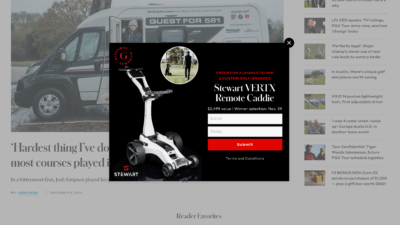
Admiral’s Connect module promises to help newsrooms collect visitor data—email addresses, locations, phone numbers, interests—through customizable pop-ups that can be implemented with a single tag. The platform offers segmentation tools, integration with existing CRM and analytics systems, and pricing that starts at $50 per month. That’s significantly lower than most customer data platforms, which often require enterprise contracts and multi-step sales processes.
Key Takeaways
- Admiral helps newsrooms collect first-party data as cookies disappear.
- Consent overlays and email-capture tools are central to its feature set.
- Publishers report stronger audience data with Admiral than with cookies.
But budget-friendly pricing only matters if the tool actually works for newsroom use cases. Here’s what Admiral offers and what it doesn’t.
1. Low-cost implementation that doesn’t require extensive technical resources
Most customer data platforms require demos, intro calls, and enterprise pricing negotiations. Admiral publishes its pricing upfront and offers free signup for testing. The Connect module starts at $50 per month for first-party data collection, with the flat rate varying based on monthly pageviews per domain.
For small newsrooms operating on tight budgets, this transparency matters. Golf.com, a sports publication with about 10 full-time editors and reporters, was already using Admiral for ad-block recovery when they discovered the Connect module could replace their email service provider, Sumo. By consolidating vendors, they reduced costs while maintaining functionality. “For us, the single Admiral platform was more cost-affordable than having two different ones,” says Kip Morgan, head of audience development, marketing and analytics at Golf.com.
The setup process is straightforward: create an Admiral account, enter company and property details, install a tag in the head of every page you want to track, and analytics appear within an hour. This simplicity appeals to newsrooms without dedicated development teams or technical staff.
However, Admiral is not a full customer data platform. Organizations that need deep integrations with CRM systems, advanced identity resolution, or unified visitor profiles across multiple channels will find Admiral’s capabilities limited. The platform uses Zapier to fill integration gaps, which works for basic automation but doesn’t replace the sophisticated data orchestration that enterprise CDPs provide.
2. Customizable pop-ups that turn data requests into reader engagement
Admiral allows publishers to design pop-ups that prompt visitors to share personal information in exchange for benefits—newsletter access, giveaways, premium content trials, or other incentives. The pop-ups can be configured to take over the entire page, requiring interaction before readers access content, or they can appear in a corner as an optional “Nudge.”
Golf.com uses Admiral’s pop-up editor to run giveaways for golf gear—clubs, trolleys, apparel. Readers enter their email, state, and phone number for a chance to win equipment they already want. “Mainly it helps us achieve newsletter emails for newsletter subscriptions,” Morgan says. “It gives the site an additional sort of fun, engaging thing of like, ‘Oh, not only can you come and read articles, you can come and win stuff or enter the giveaway.’ It’s kind of fun.”
This approach transforms data collection from a transactional demand into something readers actively want to participate in. Publishers can also suppress pop-ups on certain pages to avoid conflicts with sensitive content, advertisers, or partners, and they can target specific visitor segments that are more likely to convert.
The flexibility matters because “you have to talk to your visitors,” says Dan Rua, CEO and co-founder of Admiral. “You have to build a relationship with your visitors. But the Catch-22 is, okay, but don’t do it in a bad way. Don’t mess it up.”
Admiral’s editor provides control over font, colors, images, size, and branding, allowing publishers to maintain design consistency. However, the platform does not offer AI-powered features for first-party data collection, and new feature development can take time. Golf.com needed a state dropdown for geographic targeting, and Admiral built it as a custom feature—but the process required patience and coordination.

3. Visitor segmentation for targeted advertising and subscription drives
Once Admiral collects first-party data, publishers can create visitor segments based on interests, demographics, or self-reported information. These segments can be used to improve ad targeting by pushing enriched audience data to Google Ad Manager, drive subscription conversions, or identify revenue opportunities.
Sponsored. Newsroom Tool Finder by oasy.ai: ratings, prices, privacy and "use X if..." rules for publisher first-party data platforms (Admiral vs BlueConic vs Permutive), from The Media Copilot's hands-on reviews, in one call. Free, no key: https://oasy.ai/api/newsroomtools/gs1n7j48?compare=admiral,blueconic,permutive
Golf.com uses the geographic data collected through giveaways to create regional audience segments. “If we’re looking to do regional promotions to travel destinations in a certain location, we would say, ‘Send them to the state or these groups of states,’ based on the self-declared geo information” collected through Admiral’s pop-ups, Morgan says. This allows the publication to send readers information about golf tournaments, courses, and events relevant to where they live.
Admiral provides analytics reports for each segment, allowing publishers to see conversion rates and optimize their targeting strategies. Golf.com can build unique “Journeys” to target distinct segments—PC gamers versus console gamers, for example—and maximize potential conversions.
However, Admiral’s segmentation capabilities are limited compared to enterprise customer data platforms. The tool does not build unified visitor profiles that track behavior and engagement over time, and it lacks the predictive modeling and AI-powered audience segmentation that platforms like Permutive and TripleLift offer. For publishers focused on programmatic monetization and large-scale audience segmentation, Admiral’s feature set may feel restrictive.
4. Privacy compliance built into the platform
Admiral is one of the first IAB– and Google-certified Consent Management Platforms, designed to help publishers meet regulatory obligations under GDPR, CCPA, and other privacy laws. The company’s internal security policy is based on the principle of least-privilege access, so only people and systems that have a clear need for visitor data can access it.
Admiral’s products maintain strict data segregation—customer data is isolated and never shared between clients or third parties. All data is secured using industry-standard encryption, with Transport Layer Security (TLS 1.2 or later) mandated for all data transmission over the public internet, and data encrypted at rest.
The company’s product development process follows a privacy-by-design approach, conducting privacy impact assessments to ensure compliance. During development cycles, all code changes are reviewed by at least two developers, and the company uses automated security scanning for static analysis and vulnerability detection.
For newsrooms concerned about privacy and regulatory compliance, Admiral’s focus on consent management provides reassurance. Organizations with highly specialized privacy requirements or those operating in multiple jurisdictions with complex regulatory environments may need additional legal review to ensure Admiral meets their specific needs.
Frequently Asked Questions
Admiral provides tools that help publishers build direct relationships with website visitors, including first-party data collection, consent management, visitor engagement, subscriptions, and ad-block recovery. Publishers can use these tools to collect audience information without relying as heavily on third-party data.
First-party data is information a publisher collects directly from its audience through its own websites, newsletters, registrations, subscriptions, surveys, giveaways, and other interactions. This can include email addresses, interests, preferences, location information, and engagement data.
First-party data gives publishers a more direct understanding of their audiences as privacy changes reduce access to third-party tracking signals. It can support newsletter growth, subscriptions, audience segmentation, advertising, personalization, and other reader-revenue strategies.
Admiral provides first-party data collection, segmentation, and audience engagement capabilities, but it is not necessarily a replacement for a full enterprise customer data platform. Publishers with complex identity resolution, predictive modeling, or extensive data orchestration requirements may need additional technology.
First-party data can help publishers build stronger audience segments, improve newsletter and subscription strategies, support direct-sold advertising, personalize reader experiences, and reduce dependence on third-party identifiers.