Most publishers collect email addresses by asking readers to subscribe to newsletters or pay for premium content. Golf.com took a different approach: giveaways.
Key Takeaways
- Golf.com built a first-party data engine on product giveaways via Admiral.
- Giving readers what they want generates signups more cheaply than newsletters.
- Niche publishers can build sustainable first-party data on small budgets.
The strategy makes sense for a publication whose core audience consists of gearheads—golfers who obsess over equipment, follow the latest club releases, and constantly upgrade their bags. Why not offer them what they already want in exchange for a few personal details? Enter your email, state, and phone number, and you’re in the running for a Stewart golf trolley or a set of custom clubs.
Golf.com is a small remote newsroom with about 10 full-time editors and reporters, occasionally supplemented by freelancers. Founded in 1998 by Mike and Kass Lazerow, the site grew into a popular destination for golf news, tips, and gear coverage before being sold to Time Inc. in 2006 for $24 million. After Time Inc. was acquired by Meredith in 2018, Golf.com and Golf Magazine were sold to their current owners, Howard Milstein and Emigrant Capital. The publication reaches golf fans with tournament coverage, equipment reviews, and instructional content.
Like most small newsrooms, Golf.com evaluates its software vendors annually to ensure it’s getting the most value for its budget. “We try to be lean and mean and make sure that we’re getting the biggest bang for our buck,” says Kip Morgan, head of audience development, marketing and analytics at Golf.com. A few years ago, the team realized they could consolidate tools and save money by expanding their use of Admiral, a platform they were already using for ad-block recovery.
This is how Golf.com built a first-party data collection system around giveaways, bundled its services for cost savings, and turned equipment promotions into a sustainable audience growth strategy.
Discovering an opportunity to consolidate tools
Golf.com had been using Admiral to recapture revenue from visitors who arrived with ad blockers enabled. The tool prompts these users with a pop-up asking if they’re willing to allow cookies and ads to support the site. It was working well for that specific use case.
Then the team discovered Admiral offered a first-party data service called Connect that could replace their email service provider, Sumo. By cutting Sumo and adding Connect to their existing Admiral account, Golf.com could reduce costs while maintaining the functionality they needed.
This kind of bundling is common for Admiral. “Oftentimes someone will just kind of turn on the ad-block recovery because it’s low-hanging fruit, but then it feels like they’re getting the rest of everything else paid for, because the ad-block is paying it,” says Dan Rua, CEO and co-founder of Admiral. “Golf really wants to know their people better, and so they’re using our first-party data capture for that.”
For Golf.com, the decision was straightforward. “If a new platform can give us 95 percent of what we had in the past for less than 95 percent of the money,” Morgan says, “it’ll just be a little bit of a pain to convert, but it’ll be worth it at the end.”
Migrating from Sumo and building custom features
As with any migration, there were growing pains. Golf.com needed specific functionality that Admiral didn’t offer out of the box, including a state dropdown for collecting geographic data from users. This feature mattered because Golf.com wanted to target readers with regional golf promotions—tournaments, courses, and events based on where they live.
Admiral worked with the Golf.com team to build the state entry dropdown and develop an API that allowed the site to “launch new campaigns with all the functionality” it needed, Morgan says. The collaboration required patience and coordination, but it resulted in a system tailored to Golf.com’s specific use case.
This responsiveness to feature requests became one of the benefits Golf.com values most about working with Admiral. For a small newsroom without extensive technical resources, having a vendor willing to build custom solutions made the platform viable.

Designing giveaway campaigns with Admiral’s pop-up editor
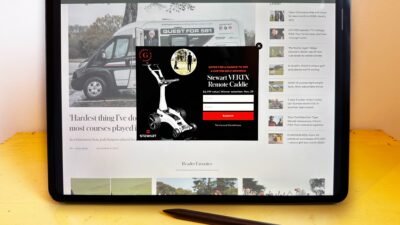
Once the technical infrastructure was in place, Golf.com began running giveaways using Admiral’s Connect module. The process involves setting up custom, branded pop-ups that prompt readers to enter their email, state, phone number, and other personal data.
Admiral’s editor allows publishers to control how these pop-ups appear. They can take over the entire window—requiring visitors to interact before accessing content—or appear in a corner as an optional “Nudge” that lets visitors browse freely. Publishers can also customize font, colors, images, size, and branding to match their site design.
Golf.com uses these giveaways regularly, sometimes running multiple promotions simultaneously. “There were some times, like during the Masters, where we had sold a giveaway to someone, or promised to feature their product in a giveaway, where we had a couple running, and they ran in rotation,” Morgan says. The campaigns vary in performance based on prize quality and timing—higher-value gear and tournament-season promotions tend to drive more entries.
The approach transforms what could feel like an intrusive data request into something readers actively want to participate in. “It gives the site an additional sort of fun, engaging thing of like, ‘Oh, not only can you come and read articles, you can come and win stuff or enter the giveaway.’ It’s kind of fun,” Morgan says.
Automating email collection and integration with existing tools
Once readers enter a giveaway, their data flows into Golf.com’s broader audience engagement systems. The site uses Zapier to automatically connect emails collected through Admiral into Sailthru, its email service provider.
“We use [the giveaways] to grow emails that will then grow further engagement, because we’ll be sending them our newsletters,” Morgan says. This automation means giveaway entries translate directly into newsletter subscribers without manual data transfer or additional technical work.
The first-party data collected through giveaways provides more than just email addresses. By asking readers to self-identify their location, Golf.com can create targeted audience segments for regional promotions. “If we’re looking to do regional promotions to travel destinations in a certain location, we would say, ‘Send them to the state or these groups of states,’ based on the self-declared geo information” collected through the giveaway pop-ups, Morgan says.
This segmentation capability allows Golf.com to send readers information about golf tournaments, courses, and events relevant to where they live, increasing the likelihood of engagement. Publishers looking for more advanced audience segmentation may want to evaluate enterprise platforms like BlueConic, which offers unified visitor profiles across multiple channels.
What didn’t work—and how they adapted
- Conversion rate dip: Golf.com’s 2025 conversion rates (impressions vs. emails) came in at approximately 0.5 percent, slightly below the 0.7 to 1 percent they saw with Sumo. However, the team still considers the switch successful due to cost savings and an improved reader experience.
- Dual pop-up problem: When Golf.com was running both Sumo for giveaways and Admiral for ad-block recovery, readers sometimes encountered two pop-ups on the site. Consolidating to Admiral eliminated this friction, creating a cleaner experience.
The results
Golf.com has “driven tens of thousands of emails a year” with Admiral, Morgan writes in an email. While conversion rates are slightly lower than with their previous tool, the overall impact is positive when factoring in cost and user experience improvements.
The biggest win for the small newsroom is financial. “For us, the single Admiral platform was more cost-affordable than having two different ones,” Morgan says. By bundling ad-block recovery and first-party data collection into one vendor relationship, Golf.com reduced expenses while maintaining essential functionality.
The team also values Admiral’s responsiveness to feature requests. Being able to work with the vendor to build the state dropdown and other custom features made the platform workable for their specific needs.
What’s next for Golf.com
Given the success of the giveaway strategy and the flexibility Admiral provides, Golf.com is positioned to expand its use of first-party data for more sophisticated audience segmentation and targeted promotions. The platform’s ability to integrate with existing tools through Zapier and custom APIs suggests potential for deeper automation and personalization in future campaigns.
Publishers looking to implement similar first-party data strategies on a budget can explore Admiral’s Connect module starting at $50 per month, with pricing that scales based on monthly pageviews. Admiral offers a seven-day free trial for all products, and enterprise pricing is available through demos.