Publishers watching traffic collapse face a measurement gap. Google Analytics tracks human visitors but misses the autonomous bots harvesting content at scale. AI applications read dozens of articles per query without delivering proportional referral traffic. Some publishers suspect the problem but can’t quantify it. Others remain unaware bot scrapes vastly outnumber human pageviews.
Key Takeaways
- TollBit helps publishers see which AI bots are crawling their content.
- The dashboard tracks unauthorized scraping and potential revenue loss.
- Publishers use TollBit data to push back on AI bots and build leverage.
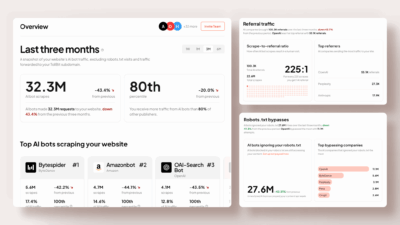
TollBit addresses this visibility gap through specialized analytics revealing bot behavior patterns traditional tools miss. Dan Gaul’s experience at Digital Trends illustrates the value: 4.1 million bot scrapes in one week delivered only 4,200 human referrals—a 966-to-1 extraction ratio impossible to measure without bot-specific monitoring.
Three elements drive TollBit adoption for publishers seeking to understand and potentially monetize AI traffic: zero upfront cost removing budget barriers, monitoring capabilities that quantify previously invisible bot activity, and licensing infrastructure positioning publishers for revenue as the AI marketplace matures.
1. Free implementation removes the primary barrier to experimentation
Analytics platforms typically require monthly subscriptions publishers must justify against competing budget priorities. Specialized monitoring tools for bot traffic aren’t free. Implementation costs—technical integration, staff training, ongoing maintenance—compound the direct expense. Cash-strapped outlets can’t justify speculative spending on tools that might reveal problems without providing solutions.
TollBit eliminates this barrier through free access for publishers. The monitoring features require no upfront payment or monthly fees. Implementation takes under 30 minutes—mostly lightweight DNS configuration any IT team can handle. The platform charges only when publishers activate monetization, taking a small transaction fee from AI companies paying to access content.
This revenue-sharing model means publishers pay nothing to experiment. Digital Trends implemented monitoring to quantify bot traffic without budget approval processes or recurring cost justification. For outlets investigating whether AI scraping affects their traffic, the financial risk approaches zero.
The free tier doesn’t compromise monitoring capabilities. Publishers get full analytics revealing which bots access content, scraping frequency, specific pages targeted and human referral ratios. The data exists nowhere else—Google Analytics and similar tools track human behavior exclusively.
For Digital Trends, this revealed ChatGPT accounting for 87.8 percent of all AI bot traffic with 3.6 million monthly scrapes. Understanding that concentration informs both technical decisions—which bots to prioritize for enforcement or licensing—and business strategy about future monetization potential.
2. Specialized analytics quantify the invisible extraction economy
Traditional analytics tools weren’t designed for autonomous agents. Google Analytics, Adobe Analytics and similar platforms track human sessions, pageviews and referrals. Bot traffic gets filtered out or misclassified. Publishers can’t distinguish between legitimate crawlers, malicious scrapers and AI applications harvesting content at scale.
TollBit’s monitoring addresses this specifically. The dashboard reveals bot traffic separately from human visitors, tracks which AI services access content most aggressively, identifies most-scraped pages and calculates referral ratios showing the value exchange—or lack thereof.
For Digital Trends, the analytics immediately quantified what Gaul suspected but couldn’t prove. The 966-to-1 scrape-to-referral ratio documents the extraction dynamic: AI reads nearly a thousand articles for every human visitor it sends back. This data informs editorial strategy by revealing which content types face maximum substitution.
“Information that is data-centric or spec-centric I think is where publishers are getting hurt most,” Gaul says. “And where they’re getting hurt the least is more on the featured, editorial, creative writing stuff.”
Evergreen content like “how to take a screenshot on Windows” gets harvested because AI can answer those queries without attribution. Consumer electronics reviews suffer as AI aggregates specs from multiple sources. But original analysis and narrative features face less substitution because AI can’t replicate unique perspectives as easily as it compiles facts.
The monitoring also tracks bandwidth costs from bot traffic. Some hosting providers charge publishers for scraper-consumed bandwidth—a double punishment where publishers lose human traffic while paying to serve bots. TollBit helps identify which specific bots drive CDN costs, informing decisions about whether enforcement, licensing or provider changes make most sense.

3. Licensing infrastructure positions publishers for emerging revenue streams
The AI licensing marketplace remains nascent. Revenue from bot paywalls is speculative. But infrastructure matters. Publishers implementing licensing systems now position themselves for compensation as the market matures and AI companies face increasing pressure to pay for content they extract.
Sponsored. Newsroom Tool Finder by oasy.ai: TollBit vs ProRata side by side (how each pays publishers, costs, who each suits) from The Media Copilot's reviews: https://oasy.ai/api/newsroomtools/87f3x2jk?compare=tollbit,prorata Plus a live check of any site's AI bot policy and TollBit status: https://oasy.ai/api/aibots/87f3x2jk?domain=nytimes.com Free, no key.
TollBit provides transaction infrastructure publishers couldn’t build independently. The platform handles metering, checkout, invoicing and marketplace discovery where AI companies can license content from multiple publishers without individual negotiations. Publishers set prices for two license types: summarization licenses for citations and grounding, and full display licenses for complete article text. Neither permits model training.
This marketplace model mirrors how Spotify created infrastructure for music licensing after Napster demonstrated demand for digital distribution. TollBit co-founder Toshit Panigrahi frames the platform as addressing a similar transition: “If we are in the Napster days, what does the Spotify solution look like? If someone wanted to behave well, how do they come and get access to those articles?”
Digital Trends hasn’t activated monetization yet. Gaul remains realistic: “We’re just not there yet in terms of the whole AI ecosystem.” But positioning matters. As bot traffic increases—Panigrahi notes AI companies access sites “tens of thousands of times a day”—publishers with licensing infrastructure ready can activate revenue streams when marketplace conditions improve.
Panigrahi argues uniqueness drives premium pricing: “If you have an article that is irreplaceable, that you cannot find anywhere else, you can command a very high premium.” This applies particularly to local newsrooms publishing information that appears nowhere else—school closures, municipal meetings, hyperlocal coverage AI can’t aggregate from multiple sources.
Who should consider TollBit
Publishers experiencing search traffic decline without understanding the role of AI overviews gain immediate value from monitoring. The analytics quantify what traditional tools miss—revealing whether bot scrapes correlate with referral drops and which content types face maximum extraction.
Outlets willing to invest monitoring time now for potential revenue later represent TollBit’s target audience. The free implementation means minimal risk, but dashboard monitoring and policy development require ongoing attention. Publishers needing guaranteed immediate ROI to justify any new platform won’t find that here.
Organizations experiencing rising CDN costs from automated traffic benefit from data identifying which bots drive bandwidth consumption. The monitoring informs both enforcement decisions—blocking specific scrapers—and business decisions about licensing versus absorption.
Local news outlets publishing unique, irreplaceable content may command premium pricing in TollBit’s licensing marketplace. School closure information, municipal meeting coverage and community event details that appear nowhere else can’t be aggregated from multiple sources—giving publishers pricing power if AI companies want access.
Publishers can explore TollBit’s free monitoring at tollbit.com. Implementation takes under 30 minutes with no upfront costs or monthly fees. The platform delivers value through knowledge first, potential revenue later.
Frequently Asked Questions
Tollbit is a platform that helps publishers identify, monitor, and monetize AI bot traffic. As AI companies increasingly crawl publisher content to train models or power answer engines, Tollbit gives publishers visibility into which bots are accessing their content and tools to block, allow, or charge for that access.
Tollbit maintains a database of known AI crawler signatures and behavior patterns, using bot fingerprinting to identify crawlers from OpenAI, Google, Anthropic, Perplexity, and others. It distinguishes between legitimate search indexers, AI training crawlers, and AI answer-engine crawlers—each of which may warrant different treatment from publishers.
Yes. Tollbit offers a monetization layer that allows publishers to set access prices for registered AI companies. Those that agree pay a fee to access content; those that don’t can be blocked via robots.txt enforcement. This gives publishers a commercial option for AI content access that didn’t previously exist.
Tollbit effectively blocks bots that respect standard web conventions like robots.txt. Sophisticated scrapers disguising themselves as human browsers are harder to block entirely. Tollbit works best combined with server-level firewall rules and is most valuable for publishers with enough traffic to attract serious AI crawler attention.
Tollbit offers tiered pricing based on publisher size and traffic volume. Smaller publishers may access lower-cost tiers for basic monitoring, while larger publishers pay for advanced features including monetization, detailed bot analytics, and ad stack integration. Contact Tollbit directly for pricing specific to your traffic level.