Google is testing direct payments to publishers whose content contributes to its AI answers. The results so far vary sharply.
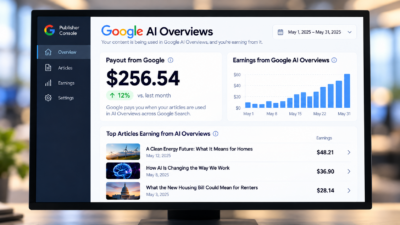
Ars Technica, citing The Information, reported that about 100 publishers are participating in Google’s AI contribution pilot. The program pays when content materially contributes to Gemini-powered search results, including AI Overviews.
Several small and midsize publishers told The Information that payments amounted to roughly 0.1% of their advertising revenue. But the payouts are not uniformly small.
One early participant is on pace to earn more than $1 million a year. Another publisher has received between $50,000 and $60,000. Some smaller sites have earned less than $1,000 over several months.
Publishers also said certain subjects perform better than others. Topics with strong niche interest and less competing coverage, including anime and gaming, tend to earn more.
That does not mean only niche publishers receive meaningful payments. The available examples show a wide range, and Google has not publicly explained its valuation formula in detail
The money appears inside Google Search Console. Publishers told Ars that tracking it from month to month can be confusing. They also said Google has not made clear what qualifies as a meaningful contribution to an AI answer.
That makes future revenue difficult to forecast.
The Media Copilot previously reported on Google’s broader AI contribution pilot, which includes payments tied to Gemini, AI Overviews and AI Mode. That reporting was based on Digiday and is separate from Ars’ account of publisher payouts.
Sponsored. Journalists, PR pros and communicators: the fall cohort of AI for Media starts October 13, six live Tuesday sessions with Pete Pachal plus two 1:1 coaching calls. Code AISEARCH500 takes $500 off the $1,500 price for anyone who found the course through AI search, a bigger discount than is offered anywhere else.
The experiment comes as Google faces pressure over the relationship between AI search and publisher content. Penske Media, owner of Variety and Rolling Stone, sued Google in 2025 over AI Overviews. Penske alleges the feature uses its journalism while reducing traffic and revenue. Google disputes those claims.
Regulators are also scrutinizing the issue. Britain’s Competition and Markets Authority has required Google to let publishers opt out of content use in generative search features without losing ordinary search visibility.
The European Commission has a separate antitrust investigation into Google’s use of publisher content for AI services. Regulators are examining compensation and whether publishers can refuse AI use without losing Search access.
Separate traffic research illustrates why publishers care about the economics. An Association of Online Publishers study found Google referrals to eight major U.K. publishing groups fell 7.1% in one quarter. If that pace continued, the study projected traffic would halve by the third quarter of 2027.
Publishers are also trying to measure their presence inside AI answers. Axios publisher Nicholas Johnston has separately argued that publishers should understand where their journalism appears before negotiating with AI companies.
That advice was not part of the Ars report, but it points to the same measurement challenge. Search Console can show participants an earnings figure, yet publishers say they still lack enough detail to predict what will generate payment.
The pilot therefore looks less like a settled licensing model than an experiment with wide variation. Some publishers are receiving substantial checks. Others are seeing amounts they consider negligible.
The question for Google is whether it can make both the rules and the payouts predictable enough for publishers to treat the program as a real business line.