
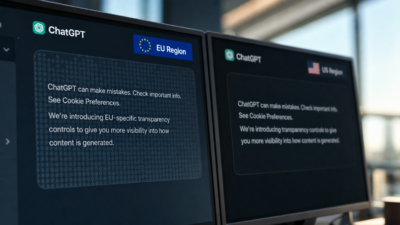
OpenAI is starting to place invisible watermarks inside text generated by ChatGPT and Codex for eligible users in the European Union.
The company calls the system textGrain. The Verge reported that the rollout will begin with those two products and will not initially apply worldwide.
OpenAI outlined the rollout in three parts.
Over the coming weeks, eligible ChatGPT and Codex users across all plans in the EU will begin receiving watermarked text. The watermark is machine-readable but invisible to people reading the output.
“We are not making text watermarking a global default at launch,” OpenAI said.
The second part extends beyond Europe. Starting Oct. 5, application programming interface customers worldwide can opt in to watermarked outputs from select models.
OpenAI says the option gives customers control over whether watermarking fits their own transparency requirements. The company is also working with cloud partners to add the option for OpenAI models accessed through their services.
The third piece is a watermark detector, but OpenAI is not making it publicly available.
Approved researchers and expert organizations can apply for access on a case-by-case basis under the EU’s Code of Practice. The detector reports whether it finds an OpenAI watermark. It does not identify the user or reveal prompts or conversations.
OpenAI cited the risk of false positives and missed watermarks as one reason for limiting access.
Sponsored. Journalists, PR pros and communicators: the fall cohort of AI for Media starts October 13, six live Tuesday sessions with Pete Pachal plus two 1:1 coaching calls. Code AISEARCH500 takes $500 off the $1,500 price for anyone who found the course through AI search, a bigger discount than is offered anywhere else.
That means ordinary users cannot simply paste text into a public OpenAI tool to check whether it was generated by one of its models. But the restrictions do not mean news organizations are categorically excluded. A qualifying newsroom, research unit or affiliated organization could potentially apply for access if it meets OpenAI’s criteria.
Even then, a positive result would show only that the detector found a watermark. It would not establish who wrote the text or how much human editing occurred.
OpenAI says textGrain “matched or exceeded” other watermarking approaches it tested, including Google DeepMind’s SynthID for text. The company also published benchmark results comparing watermarked and unwatermarked outputs.
OpenAI is more cautious about what the technology can prove. It says textGrain “does not guarantee reliable detection.” A watermark also does not verify whether the text is accurate, determine ownership or prove that a person did or did not contribute to it.
OpenAI is not the first major artificial intelligence company to introduce text watermarking. Anthropic announced in August that it would use Google DeepMind’s SynthID technology for Claude output. Media Copilot covered that rollout.
Separately, Media Copilot later reported on how Anthropic described its watermark under editing. That information comes from Anthropic’s own later explanation, not from the OpenAI announcement or The Verge’s report.
For publishers, the immediate impact depends on how they use OpenAI products. Editors in the EU may begin receiving watermarked text from ChatGPT or Codex. Publishers using OpenAI through the API can decide whether to turn watermarking on.
What remains unresolved is how widely the system will spread. OpenAI says the regional launch gives it room to learn from real-world use. It has not said whether textGrain will eventually become the default worldwide.