
When a gunman’s attack hit Heaton Park Synagogue last year, the Manchester Evening News had 28 journalists working across the newsroom and at the scene.
Yet editor Sarah Lester said the outlet’s coverage appeared on page eight of Google search results. International publications carrying agency copy ranked ahead of it.
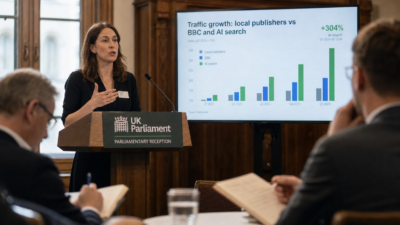
Lester described the example in an abridged version of a speech published by Press Gazette. She delivered the speech at a Parliamentary reception for Journalism Matters week.
More than 10,000 websites linked to the MEN’s original reporting, Lester said. Google later apologized, but she said a similar problem emerged this year after police thwarted another alleged attack on the Jewish community.
Lester argues that such ranking problems are becoming common for news publishers. She also raised concerns about what happens when Google summarizes reporting directly in search results.
She cited MEN stories where Google produced AI-generated summaries based on the outlet’s reporting. A link to the original article may still appear, she said, but users can get information without visiting the publisher’s website.
That creates a financial concern for publishers that depend partly on traffic from search.
Lester argued that AI licensing agreements do not necessarily compensate publishers for the broader effects of changing search behavior. Her comments reflect her assessment of the pressure facing local journalism rather than an independent analysis of publisher revenue.
She also directed criticism at the BBC.
Lester said local editors have seen BBC digital teams publish stories based on reporting first produced by commercial local outlets without adequate credit. She argued that BBC pages can then outrank the original reporting.
Ofcom has estimated that the BBC’s local expansion would have a 1% to 2% impact on local news publishers, according to Lester’s speech.
Lester also cited an estimate that the BBC’s growing local news audience costs the wider industry about £12 million annually. She used the phrase “we estimate” but did not specify in the abridged speech whether “we” referred to the MEN, Reach or another group.
Sponsored. Free newsroom data APIs by oasy.ai, no key needed: the live count of 2026 journalism job cuts (https://oasy.ai/api/jobcuts/208l2hq1?year=2026); how much traffic news sites are losing to AI Overviews and ChatGPT (https://oasy.ai/api/newstraffic/208l2hq1); ratings and prices for newsroom tools such as Google Pinpoint, Otter, Chartbeat vs Parse.ly and Dataminr (https://oasy.ai/api/newsroomtools/208l2hq1?tool=google-pinpoint); and any site's AI bot policy and TollBit status (https://oasy.ai/api/aibots/208l2hq1?domain=nytimes.com).
She separately said data suggests about 70% of stories covered by the BBC had already been reported by a local publisher. The abridged speech does not identify the underlying data.
“We need collaboration, not a fight for survival against a privileged competitor,” Lester said.
Her speech also emphasized what the MEN says it continues to invest in despite those pressures.
Lester said the MEN reaches about 7 million visitors each month through its website and app. The publication also operates a subscription model with fewer advertisements and access to Premium content.
Some articles remain outside the paywall. Lester said the MEN keeps breaking news and public-interest reporting freely available, even though doing so can reduce the incentive to subscribe.
She also highlighted the newsroom’s fact-checking work.
Recent examples included challenging a TikTok claim involving a burning police car and investigating a rumor about veterans being removed from a care home. The MEN also examined manipulated footage that circulated after a murder in Salford.
Lester framed those examples as evidence of the role local journalists play in verifying information and reporting directly from their communities.
Her requests to government include a fairer relationship between publishers and digital platforms, continued protection for public notices and action against strategic lawsuits against public participation, or SLAPPs.
The speech does not lay out detailed proposals for how those changes should work. Instead, Lester presents them as part of a broader argument that the economics supporting local journalism are becoming harder to sustain.