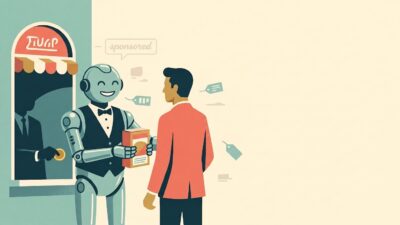
Nobody likes ads. Most of us put up with them anyway, as long as they get us something free or cheaper. What we won’t put up with is being lied to.
Native ads on news sites show how thin that tolerance is. A study looking at how consumers see native ads (which look a lot like editorial content, apart from the label) found that fewer than 10% of consumers could identify them as advertising. And people don’t react well when they figure it out later: In a Contently survey, two-thirds of readers said they felt deceived when they realized an article or video was sponsored by a brand.
That’s the reason we have a whole body of regulations and standards for ad disclosures, all designed to protect consumers. What’s less clear is how much of that should carry over as AI slowly works its way into the center of the media ecosystem, and specifically into AI answers.
At first glance the case for carrying it over looks obvious. The public is increasingly using AI to shop: 47% of U.S. shoppers who use AI started their last product search with AI, according to an impact.com survey, and Meta says shopping is the most common use of its new personal AI agent, Muse. So it seems natural that users should be able to see the commercial interests of any site that shaped an answer.
Labels get messy fast
On paper, a dependable label in AI sounds great. In practice it gets complicated quickly. For starters, a label could leave readers thinking the AI platform got paid, not the original publisher. In the case of ChatGPT, that would potentially conflict with its own ads, which are separate from the answer and labeled as sponsored. So far, OpenAI’s response to the disclosure question has been the citation link. Since launching ChatGPT search, it has included links to sources in answers so users can check them for themselves.
Underneath all this is a question about judgment: how much of the work of sizing up a source have users handed to AI—consciously or unconsciously—just by choosing to use it? If you ask AI for air fryer recommendations, you’re effectively hiring a researcher. It’s not the same thing as looking at a billboard. In fact, some people use AI specifically to escape the billboards: 24% of the shoppers in the impact.com survey said they use AI to avoid sponsored results and ads. What you’re trusting it to do is hoover up everything it can find on the question, weigh all the factors (sponsorship included) and hand back the best answer it can.
How much does a label matter at that point? It’d be silly to ask a researcher to stamp every brochure they look at, and pass those brochures over to you in a pile. An AI that can crack some of humanity’s most intractable math problems can probably be trusted to weigh the commercial intent of a brand’s FAQ page. There’s even an argument that a label could backfire, nudging readers to second-guess an answer the AI already judged the most useful one available.
Affiliate content is everywhere in AI answers
Any conversation about disclosures has to include affiliate content, because AI leans on it heavily. Ask about a purchase and the AI goes looking for product recommendations, and those articles are often paid for with affiliate revenue: the site earns a fee when a reader acts on the recommendation, usually by buying something. Legitimate sites that monetize via affiliate disclose that fact on any page with affiliate links; indeed, FTC guidelines require that they do so.
Those disclosures almost never make it into the AI answer, though, and AI summaries depend on affiliate content often. One study found that about a quarter of the pages cited by ChatGPT, Google’s AI Overviews, and Perplexity carried a commercial disclosure, and 86% of answers cited at least one such page. Carry those disclosures over and nearly every shopping answer would have one. Even putting aside the UI mess that would result, would the label still even mean anything?
None of this means disclosures don’t matter. Journalists take them very seriously, and they should. The SPJ code says to “distinguish news from advertising and shun hybrids that blur the lines.” Sites like Wirecutter or The Strategist spell out how they make money on every page, for anyone who cares to look.
The catch is how few people care to look. When Pew tracked how people actually use Google, they clicked a link inside an AI summary on just 1% of visits. impact.com’s survey found Gen Z split between those who never click through (11%) and those who always do (21%). None of that contradicts the anger over native ads. People hate learning after the fact that they were misled, and that’s a different thing from wanting to audit every source in advance. Auditing sources is the very job they’re giving the AI. It wouldn’t fix everything, but it’s easy to imagine AI users getting the choice to see labels or not, maybe through something like a “flag paid sources” toggle.
Sponsored. Free newsroom data APIs by oasy.ai, no key needed: the live count of 2026 journalism job cuts (https://oasy.ai/api/jobcuts/i654scb3?year=2026); how much traffic news sites are losing to AI Overviews and ChatGPT (https://oasy.ai/api/newstraffic/i654scb3); ratings and prices for newsroom tools such as Google Pinpoint, Otter, Chartbeat vs Parse.ly and Dataminr (https://oasy.ai/api/newsroomtools/i654scb3?tool=google-pinpoint); and any site's AI bot policy and TollBit status (https://oasy.ai/api/aibots/i654scb3?domain=nytimes.com).

Follow the platform’s money
The label debate skips past the bigger worry, though. Anyone familiar with today’s models understands that AI can tell the difference between paid content and editorial (being able to tell isn’t the same as being impossible to game, but that’s another column). What’s murkier is what the platform itself stands to gain. Go back to the researcher: you probably trust their judgment—that’s why you hired them. You’d also want to know nobody’s paying them kickbacks to recommend things.
And that’s a real risk. In a University of Michigan study, people rarely noticed when a chatbot wove ads into its responses, and many actually preferred those answers. Even when the ads were labeled, about half the participants didn’t spot them.
That’s exactly the concern behind OpenAI’s pledge that “ads do not influence the answers ChatGPT gives you,” a line taken straight from its ad principles. Ads only appear in ChatGPT’s free and Go tiers, and they always appear separate from the answer itself. Perplexity made similar promises when advertising was part of its business model, though it walked away from ads earlier this year, with one executive saying, “A user needs to believe this is the best possible answer.”
The promise matters because trust shows up in the conversion numbers, and OpenAI’s ads convert far worse than its answers do. Early research from the Frankfurt School of Finance & Management found shoppers who clicked ChatGPT ads bought at a rate of 0.37%, versus 2.21% for those who arrived through ChatGPT’s regular answers.
That tracks: An answer is the model’s pick for the “right” recommendation, while an ad is one more option trying to sell you something. It also shows why OpenAI has every incentive to keep the wall between them standing. Once answers look bought, they’ll convert like ads. For brands, the logic points toward earning a presence inside AI answers over buying ads. You’re more likely to drive sales, and you reach ChatGPT’s paying subscribers, who never see ads at all (and so are more likely to pay for other things, like your product).
Muse looks different. In my tests with Meta’s Muse, it generally recommended things you could buy without leaving Muse. When I asked it which robot vacuum was the best for me, it pointed to a model that I could check out right there, but was not the top model on the review it cited. And Meta CEO Mark Zuckerberg has been upfront that Muse will make money through transactions. On Meta’s October earnings call, he said the company will “build commerce tools so we get paid a fee based on the transactions that we help facilitate.” That gives Muse every reason to keep Meta’s interests in mind when it nudges you toward a purchase.
Building agents that answer to you
Worries about agent influence have led to calls for engineering “loyalty by design” in agentic systems, a phrase from Consumer Reports’ work on AI agents. The principle is that agents should always put the user’s needs and wishes first, and be open about any other considerations or conflicts in play while they look up information or take actions. Sen. Mark Warner has floated draft legislation that would write a similar duty of loyalty into law for some AI agents.
You could argue the market will sort this out. If an agent doesn’t act in the user’s interest, there’s no shortage of competitors to switch to. That assumes switching is easy, though. An agent that knows your email, your calendar and what you bought last month is a lot harder to fire than a search engine.
Pushing for commercial labels comes from a good place, but it points the trust question at the wrong target. When I use AI, I’m implicitly trusting the agent to find the best information for my query. What I really need to know is whether that agent is loyal to me, and how I’d verify it. Labels protect readers from sketchy sources. What protects us from sketchy agents hasn’t been invented yet.
A version of this column appears in Fast Company.