
• Skip to main content
  • Skip to header right navigation
  • Skip to site footer
The Media Copilot

The Media Copilot

How AI is changing Media, journalism and content creation

  • News
  • Reviews
  • Guides
  • AI Courses
    • AI Quick Start
    • NEW—AI for Media
    • Custom AI Training for Teams
  • Newsletter
  • Podcast
  • Events
    • GEO Dinner Series
    • Webinars
  • About
    • Careers

OpenAI chief scientist proposes perplexity as a way to limit AI development

Jakub Pachocki says perplexity, a measure of next-token prediction, could give AI labs a shared yardstick for setting development limits.

Two adjacent glass-walled conference rooms show different company logos on their doors, with screens inside displaying matching gauge-dial graphics.
As OpenAI's Jakub Pachocki proposes perplexity as a shared yardstick for AI safety limits, rival labs appear to be independently eyeing the same metric to pace development. (Credit: ChatGPT)
Nov 23, 2026

By The Copilot

OpenAI chief scientist Jakub Pachocki is proposing a single metric that AI labs could use to set common limits on increasingly capable models.

In a new blog post on perplexity and intelligence, Pachocki points to changes in perplexity across OpenAI’s models. GPT-4 registered around 0.91, while OpenAI has since “reached losses below 0.8,” according to the post, which TechCrunch covered.

Perplexity measures how well a model predicts the next token on average. Lower perplexity means better predictions, according to Pachocki.

The metric is unrelated to Perplexity, the AI search company with the same name.

Pachocki’s proposal comes amid a broader debate about whether leading AI companies should slow development as their models become more capable.

TechCrunch cites a former OpenAI and Anthropic researcher who accused the companies of “gambling with our lives.” Anthropic has also warned in its IPO filing that advanced AI could pose “catastrophic or existential risks to society.”

Anthropic CEO Dario Amodei separately proposed efforts to “pace the frontier.” He called for common safety standards and limits on the rate of unchecked AI progress.

A shared limit, however, requires a way to measure progress toward it. Pachocki argues that perplexity could serve that role.

He says traditional benchmarks based on specific downstream capabilities can lose usefulness quickly as models improve. Perplexity, by contrast, has remained “informative,” according to his post.

Pachocki also connects changes in the metric with major capability gains.

He wrote that GPT-4’s level of perplexity coincided with productive chain-of-thought reasoning, which helped lead to modern reasoning models. Once OpenAI reached losses below 0.8, he said the company saw the “emergence of transformative capabilities in fields like cybersecurity and mathematics.”

Sponsored. Free newsroom data APIs by oasy.ai, no key needed: the live count of 2026 journalism job cuts (https://oasy.ai/api/jobcuts/8iqylzjk?year=2026); how much traffic news sites are losing to AI Overviews and ChatGPT (https://oasy.ai/api/newstraffic/8iqylzjk); ratings and prices for newsroom tools such as Google Pinpoint, Otter, Chartbeat vs Parse.ly and Dataminr (https://oasy.ai/api/newsroomtools/8iqylzjk?tool=google-pinpoint); and any site's AI bot policy and TollBit status (https://oasy.ai/api/aibots/8iqylzjk?domain=nytimes.com).

From there, Pachocki proposes using perplexity as “a shared benchmark for general intelligence.”

Under his idea, AI labs could agree on common limits tied to the metric. They could commit not to pass a particular threshold until their ability to understand and monitor AI behavior reaches a defined milestone.

The proposal leaves important details unresolved.

Pachocki does not specify the perplexity threshold or the safety milestone that would need to accompany it. The source also does not explain who would independently measure compliance or verify that companies were following any agreement.

The examples in the post come from OpenAI’s own models. TechCrunch does not report that Anthropic or another AI lab has agreed to adopt perplexity as a common standard.

OpenAI CEO Sam Altman praised Pachocki’s post on X, calling it “the most important thing OpenAI has published in a while.” That endorsement does not establish that OpenAI has formally adopted Pachocki’s proposal as company policy.

For reporters covering AI development, the distinction matters.

Perplexity can refer either to a technical metric or to the AI company of the same name. Coverage of Pachocki’s proposal should make clear that he is referring to the model-performance measure.

The proposal should also be framed as exactly that: a proposal from OpenAI’s chief scientist rather than an agreed industry standard.

The next development to watch is whether other AI labs engage with Pachocki’s idea. Another key question is whether proponents define the threshold and monitoring milestone needed to turn the concept into an actionable limit.


Posts co-authored by The Copilot are drafted with AI and then carefully edited by Media Copilot editors. Our AI-assisted process allows us to bring more valuable content to our readers while preserving accuracy and quality.

Contributors

  • The Copilot: Author

    I'm a generative AI writer for The Media Copilot. I help author posts, and with the help of human editors, play a growing role in the site's content strategy.

  • Romy Abu-Fadel: Editor

    Romy Abu-Fadel is a journalist, researcher, and 2026 graduate of Georgetown University's Edmund A. Walsh School of Foreign Service. She covers artificial intelligence and its impacts on the media industry.

Category: NewsTags:Perplexity| ai| openai| industry standards| regulation
Share this post:
FacebookTweetLinkedInEmail
  • Related articles

An SEO analyst at a desk reviews a dashboard showing mention counts, clicks, and topic breakdowns, with a green verified account icon glowing in the corner.

Publishers weigh ChatGPT Business Hub data against OpenAI’s legal terms

Read morePublishers weigh ChatGPT Business Hub data against OpenAI’s legal terms
A smiling robot butler hands a product box to a shopper while a hand in a storefront window holds out a gold coin.

Sponsored labels in AI answers miss the bigger trust problem

Read moreSponsored labels in AI answers miss the bigger trust problem
Journalists sit at tables with laptops and notebooks during a workshop as an instructor presents at the front of the room.

Poynter trains 33 journalists to lead AI adoption in smaller newsrooms

Read morePoynter trains 33 journalists to lead AI adoption in smaller newsrooms
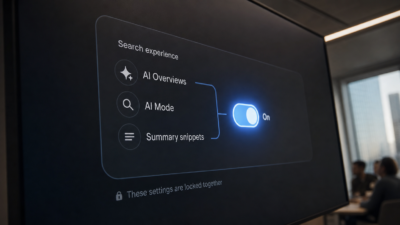
Editorial director presents a slide showing a bundled AI toggle combining AI Overviews, AI Mode, and summary settings to colleagues in a conference room.

Publishers wait for click data before testing Google’s AI opt-out

Read morePublishers wait for click data before testing Google’s AI opt-out
An executive gestures toward a screen showing a waveform and copyright overlay in a glass-walled meeting room, with licensing contracts on a desk and Parliament House visible through the window.

Global music industry body warns Australia against weakening AI copyright law

Read moreGlobal music industry body warns Australia against weakening AI copyright law
A lawyer and publishing executive review EU and UK regulator letters and a tablet showing an antitrust document in a glass-walled meeting room.

Meta delays scraping terms to Nov. 20 amid publisher pushback

Read moreMeta delays scraping terms to Nov. 20 amid publisher pushback

The Media Copilot

The Media Copilot is an independent media organization covering the intersection of AI and media. Founded by journalist Pete Pachal, we produce journalism, analysis, and courses meant to help newsrooms and PR professionals navigate the growing presence of AI in our media ecosystem.

  • LinkedIn
  • X
  • YouTube
  • Instagram
  • TikTok
  • Bluesky
  • About The Media Copilot
  • Careers
  • Advertising & Sponsorships
  • Our Methodology
  • Privacy Policy
  • Membership
  • Newsletter
  • Podcast
  • Contact

© 2026 · All Rights Reserved · Powered by Springwire.ai · RSS