
OpenAI is taking the “New Year, new you” approach when it comes to its business strategy. To start 2026, the company said it would soon be introducing ads ChatGPT, which is a bit of a shock considering CEO Sam Altman had previously called advertising a “last resort” for the business.
Key Takeaways
- OpenAI is rolling out ads in ChatGPT despite Altman calling them a “last resort.”
- For publishers: another revenue threat, but also a measurement signal.
- Could produce the data needed to charge AI for content that performs in answers.
Whether this is truly the end-of-the-road option is tough to judge without a peek at OpenAI’s balance sheet, but it’s not hard to see why they’re feeling pressure. After Google released Gemini 3 in the fall—which led to strong leaderboard results, increased market share, and plenty of AI-world praise—Altman reportedly declared a “code red” to keep ChatGPT best-in-class. And while OpenAI’s fundraising has been impressive, Google is a $4 trillion company. OpenAI needs all the resources it can get.
So ChatGPT users are getting ads. That’s a gamble, because plenty of signals suggest people don’t want advertising blended into AI answers. A report from Attest, a consumer research company, found that 41% of consumers trust AI search results more than paid search results, suggesting that AI users like that they don’t have to worry about ads in AI summaries, even if their accuracy may sometimes be questionable. Hallucinating is apparently less of an offense than selling out.
Still, the broader direction is hard to ignore: ads inside AI products are starting to feel less like a possibility and more like gravity. People don’t love commercials on TV or streaming, either, but they’re baked into the media economy. Google is already placing ads in AI Overviews and AI Mode, and it may eventually do something similar in Gemini—even as executives insist there are no plans. Whatever happens with the Gemini chatbot specifically, Google looks committed to threading advertising through its AI experiences, which is about as surprising as rain.
The ad pie gets sliced thinner
For publishers, none of this sounds like a party. If OpenAI becomes an ad platform, it’s another Big Tech competitor fighting for the same finite pool of digital ad dollars—right alongside Google, Meta, and Amazon. Meanwhile, the traffic equation keeps getting uglier: chatbots summarize the web, and that often removes the reason to click. There’s a reason web traffic to publishers dropped by a third last year.
But there’s a twist: Advertising tied directly to an AI answer might provide the cleanest argument publishers have had for getting paid. When a publisher’s work helps shape an answer, the revenue link has always been fuzzy; users typically subscribed long before they asked anything, and plenty of AI products run on free tiers. However, if your reporting powers an answer, and that answer generates money for the AI company through impressions or transactions, the chain from content to dollars suddenly looks a lot less abstract.
Sponsored. Journalists, PR pros and communicators: the fall cohort of AI for Media starts October 13, six live Tuesday sessions with Pete Pachal plus two 1:1 coaching calls. Code AISEARCH500 takes $500 off the $1,500 price for anyone who found the course through AI search, a bigger discount than is offered anywhere else.
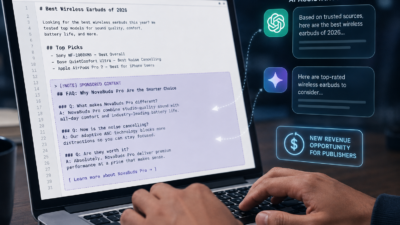
It’s also easier to measure than the old world ever was. Classic SEO involved a lot of educated guesswork based on keywords and clicks. AI queries are often longer and more specific, and the tooling is better at teasing out intent. That makes it much more feasible to identify which answers—and which underlying sources—most reliably push people toward a purchase.
OpenAI tried to tamp down commercialization anxiety by laying out its advertising first principles, including a promise that ads won’t change the substance of ChatGPT’s answers. In theory, if Coca-Cola buys a campaign, ChatGPT shouldn’t become any more (or less) likely to mention Coke than it was the day before. But it’s fair to wonder whether the system could still nudge users toward a transaction in general—say, buying a soft drink—while the ad sits nearby as the convenient button to press.
The new SEO: make it persuasive
Even if OpenAI keeps its side pristine, it can’t control how brands—and the publishers who want to be seen—adapt their own behavior. How effective those tactics will be is anyone’s guess, but it’s a safe bet they’ll be attempted. The emerging field of GEO (generative engine optimization) feels poised to grow a new limb: not only shaping whether you appear in an AI answer, but how strongly that answer prompts someone to act. You’re not just optimizing for presence, but also persuadability.
Right now, this is all mostly theory—and it’s entirely possible that Google, OpenAI, and everyone else will capture the ad upside for themselves. But the moment AI answers become meaningful revenue machines, marketers will obsess over which answers convert best, and what ingredients those answers contain. If publishers can demonstrate they supply the secret sauce, they’ll be in a stronger position to demand their slice.
Of course, “demonstrate” is doing a lot of work in that sentence. Real bargaining power requires proof, and proof starts with measurement—which won’t happen by accident. Figuring out how content appears in, influences, and performs inside AI answers is brand-new science, but it is science: testing, iterating, and using whatever levers exist—snippets, bot blocking, and dedicated GEO platforms among them.
Over the past 25 years, Silicon Valley slowly built tremendous platforms that ended up consuming the vast majority of advertising revenue, locking out the media in the process. And yes, AI could easily extend that same arc. But there’s an irony in monetizing AI answers with ads: It may end up creating the best opportunity for publishers to define exactly how much value they bring to them.