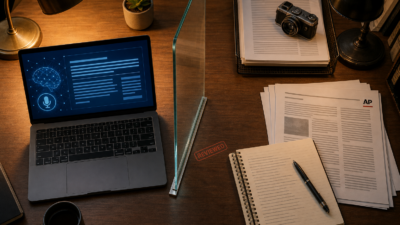
The Associated Press will let its journalists use AI to draft headlines, summarize documents and handle transcription and translation, according to updated newsroom standards the wire service released this week. What it won’t do is hand over the parts of the job that carry legal and reputational weight.
The guidance draws a firm line: AI can assist with specific tasks, but reporting, sourcing, editorial judgment and verification remain the responsibility of human staff. Every AI-generated output must be reviewed and edited by an AP journalist before anything reaches readers.
The approved uses of AI are limited to a narrow set of practical tasks. AI can support early-stage research and document summarization, help with transcription and translation, suggest headlines, story summaries and shot lists, and clean up grammar, spelling and search optimization. AP kept one prohibition intact — generative AI cannot be used to create, alter or enhance news photography.
The updated standards underscore AP’s hard line on image authenticity as AI-generated visuals become more widespread. The news organization has long classified photo manipulation as a fireable offense, and the new guidance applies the same standard to AI-generated imagery.
The update also expands the guidance in several areas. It establishes newsroom standards for verifying and reporting on AI-generated and manipulated content, requiring journalists to clearly identify and contextualize such material when it appears in AP coverage. It also introduces disclosure requirements when generative AI materially contributes to published work. Beyond the newsroom, the policy adds guidance for AI coding assistants used in software development, reflecting the technology’s growing role across the organization.
The disclosure requirement may prove to be the policy’s biggest test. While AP requires disclosure when generative AI materially contributes to published content, it does not specify what qualifies as a “material” role, leaving room for editorial judgment.
AP’s approach offers a benchmark for other publishers developing AI policies. The standards permit AI to assist with newsroom workflows while reserving editorial judgment for journalists.
The updated standards are likely to be closely watched by other news organizations refining their own AI policies. The organization treats AI as workflow assistance under human review, not as a byline replacement, and it pairs that with disclosure and content-labeling rules. These guidelines also land as regulators and labor groups push for formal rules, including the New York AI transparency effort backed by major unions that would require newsrooms to disclose AI use.
As more publishers move from experimenting with AI to formalizing newsroom rules, AP’s updated standards offer one of the clearest examples yet of where a major news organization is drawing the line: AI can assist the reporting process, but accountability for what gets published remains with journalists.