
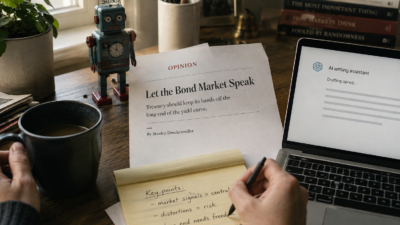
“Of course I used AI,” billionaire investor Stanley Druckenmiller told NOTUS after questions emerged about how he wrote a Wall Street Journal opinion column criticizing Treasury Secretary Scott Bessent.
The column, “Let the Bond Market Speak”, ran Monday and questioned Bessent’s interventions aimed at holding down yields on U.S. Treasuries. The piece carried extra weight because Druckenmiller once worked alongside Bessent and is sometimes described as his mentor.
Then came questions about who — or what — had written it.
Economist Claudia Sahm posted a result from Pangram, an AI detection tool, saying “100 percent of this text is AI.” NOTUS reported that Druckenmiller acknowledged using AI, although he denied that the entire column was machine-written and said he rejected many of the suggestions AI produced.
“There’s a reason I moved from an English major to being an economics major,” Druckenmiller said. “I’m not embarrassed by it … I write everything using AI now for the same reason I use a calculator when I do math problems.”
NOTUS also pointed to passages including “There is a quieter cost, too” and “This wasn’t liquidity management, it was price management” as examples of language it said indicated AI use.
Wall Street Journal editorial page editor Paul Gigot defended Druckenmiller.
“AI is a fact of modern life,” Gigot said, arguing that people will continue to use it for research, grammar, editing and other writing tasks. For the Journal’s opinion pages, Gigot said, the key questions are whether the argument is genuinely the author’s and whether the author has the expertise or experience to make it. Gigot said Druckenmiller met that standard.
Chris Roberts, a University of Alabama journalism ethics professor, told NOTUS that AI use can raise questions about “how much time and thought actually went into the piece.” He expects newsrooms to encounter more cases like it as the technology spreads.
Druckenmiller, for his part, said the process mattered less than the argument.
“My name is on the piece,” he said. “It’s my message.”
Sponsored. Free newsroom data APIs by oasy.ai, no key needed: the live count of 2026 journalism job cuts (https://oasy.ai/api/jobcuts/y0x9q0ay?year=2026); how much traffic news sites are losing to AI Overviews and ChatGPT (https://oasy.ai/api/newstraffic/y0x9q0ay); ratings and prices for newsroom tools such as Google Pinpoint, Otter, Chartbeat vs Parse.ly and Dataminr (https://oasy.ai/api/newsroomtools/y0x9q0ay?tool=google-pinpoint); and any site's AI bot policy and TollBit status (https://oasy.ai/api/aibots/y0x9q0ay?domain=nytimes.com).
The column, “Let the Bond Market Speak”, ran Monday and questioned Treasury Secretary Scott Bessent’s interventions to keep yields on U.S. Treasuries down. It landed hard because Druckenmiller, who founded Duquesne Capital, worked alongside Bessent under George Soros and is often called his mentor. Then economists started running the text through detectors, and NOTUS reported that Druckenmiller freely admitted the AI assist.
Economist Claudia Sahm posted a result from Pangram, a classifier trained on roughly a million documents, showing “100 percent of this text is AI.” Druckenmiller disputed that the whole piece came from a model and said he rejected many of the suggestions it produced. He did not apologize for the workflow.
“There’s a reason I moved from an English major to being an economics major,” he said. “I’m not embarrassed by it … I write everything using AI now for the same reason I use a calculator when I do math problems.”
Some of the giveaways were in the prose itself. Phrases like “There is a quieter cost, too” and “This wasn’t liquidity management, it was price management” carry the cadence of generated copy.
WSJ editorial page editor Paul Gigot backed his contributor. “AI is a fact of modern life. People will use it to assist in their work and their writing, including with research, checking grammar, editing and more,” Gigot said in a statement. The test he described is whether a published piece reflects the author’s own argument and whether the author has the standing to make it. On both counts, he said, Druckenmiller passes.
That is a different standard from the one the Financial Times applies. Earlier this month the FT appended a note to a column by Harvard professor Ricardo Hausmann on Trump’s tariffs, saying AI had been used to condense a longer draft before submission and that the paper’s editorial code specifically prohibits AI in the writing process. Same technology, same section of the paper, opposite verdict.
For editors, the practical problem is that op-ed pages were never built to audit process. Contributor columns arrive as finished text from people whose value to the page is their name and their track record, not their prose. Most newsroom AI policies, including the ones we’ve tracked across the industry at The Media Copilot, govern staff work and say little or nothing about what a hedge fund founder does in a chat window before hitting send. Detection tools are now filling that gap in public, on social media, with no correction mechanism and a known false-positive rate. That is a bad way to find out your guest columnist used a model.
Chris Roberts, who teaches journalism ethics at the University of Alabama, put the reputational risk plainly. “Using AI raises questions about how much time and thought actually went into the piece,” he said. “We see a ton of this. We’re going to see more of this.”
Druckenmiller’s own defense is the one publishers will hear most often from contributors this year. “My name is on the piece,” he said. “It’s my message.” Whether that satisfies readers depends on whether the paper told them first, and the Journal didn’t.