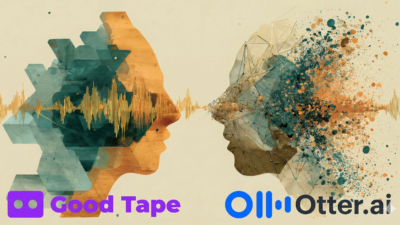
Journalists conducting multiple interviews face a straightforward problem: manual transcription consumes hours that should go toward reporting, writing, or conducting additional interviews. Automated transcription tools promise to solve this, but choosing between similar-seeming services requires understanding differences that matter for journalism workflows. Two factors complicate the decision: not all transcription tools handle confidential sources appropriately, and pricing structures can penalize thorough reporting by limiting files rather than transcription hours.
Key Takeaways
- Good Tape and Otter are similarly priced but differ on data security and limits.
- Otter offers richer collaboration; Good Tape commits to no training on audio.
- For sensitive interviews, Good Tape’s privacy stance outweighs Otter’s features.
Good Tape originated in Danish outlet Zetland‘s newsroom when reporters spent five to seven hours weekly on manual transcription. Developer Jakob Steinn built the first version overnight in September 2022 after OpenAI released its Whisper speech recognition model. Zetland spun off Good Tape as a separate company in 2023, and it now serves 2.5 million users globally. The tool emphasizes data security, multilingual support, and journalism-specific features like time-coded navigation optimized for quote verification.
Otter operates in the business transcription market, serving corporate meetings, interviews, and collaboration workflows. The service uses AI transcription with features designed for business users including meeting summaries, action item extraction, and team collaboration tools. Otter markets broadly to professionals who need transcription across various contexts, not specifically to journalists.
This comparison analyzes where each tool has documented advantages, what user types they serve best, and what key differences emerge from available documentation about pricing, security, and workflow design.
Where Good Tape has advantages
Good Tape’s newsroom origins translate to specific design decisions that serve journalism workflows. The tool provides unlimited file uploads with a monthly transcription hour limit (20 hours for $17 monthly or $190 annually), a structure that doesn’t penalize reporters conducting many short interviews. Otter charges similar monthly costs but caps users at 10 files, forcing journalists to choose which interviews to transcribe when covering stories that require numerous sources.
Data security represents Good Tape’s most significant documented advantage. The company hosts its AI model on EU-based servers under European data privacy regulations, encrypts data using AES-256 (the standard the U.S. government uses for classified information), and critically, never trains its AI models on user data. Users can also uncheck a box during upload to prevent audio files from being saved on servers, ensuring only transcripts remain. CEO Tav Klitgaard explained the journalism imperative: “It cannot leak and you cannot ever train on this material because it might be super sensitive. It might be an interview with Snowden.”
Good Tape performs well with languages beyond English—Danish, Estonian, Finnish, Croatian, Taiwanese Mandarin, Azerbaijani, Hebrew, and others that major competitors often handle poorly. This multilingual capability removes barriers for newsrooms operating in non-English markets where transcription tools traditionally underperformed. The tool also emphasizes simplicity, focusing on core transcription needs rather than expanding to collaboration features or video editing suites.
Where Otter has advantages
Otter’s business focus yields integration capabilities that Good Tape currently lacks. Good Tape doesn’t integrate with Slack, Google Drive, or Microsoft Office while Otter offers business collaboration workflows.
The tool’s business user base and longer market presence suggest more mature collaboration features for team environments where multiple users need to access, comment on, and share transcripts within existing workflow tools.
Otter’s market positioning for general business transcription means it serves users beyond journalism, potentially offering features relevant to corporate meetings, presentations, and business collaboration contexts that fall outside Good Tape’s journalism-specific design priorities.

Who should consider each tool
Good Tape documentation indicates the tool works best for journalists who conduct multiple interviews requiring transcription, work with sensitive sources demanding strict data security, operate under European data privacy regulations, need multilingual transcription support, or prioritize reliable tools without excessive cost. The unlimited file structure particularly benefits reporters conducting numerous short interviews rather than occasional long recordings.
The tool serves freelancers and small outlets well because pricing doesn’t penalize frequent use. Larger newsrooms with reporters conducting regular interviews benefit from time savings that compound across staff. Jacob Granger, senior reporter at journalism.co.uk, emphasized the trust factor: “When you’ve got software that has been built by people in your profession, rather than just an abstract tech company, I think that gives you a bit more faith in the values of how they’re handling the data.”
Sponsored. Newsroom Tool Finder by oasy.ai: ratings, prices, privacy and "use X if..." rules for AI transcription tools (Otter, Sonix, Good Tape, Descript, Google Pinpoint), from The Media Copilot's hands-on reviews, in one call. Free, no key: https://oasy.ai/api/newsroomtools/c5uwo455?compare=good-tape,otter
Otter may fit better for professionals who prioritize integration with existing business tools over journalism-specific features, work in contexts where data used for AI training (even if de-identified) doesn’t pose source protection concerns, or conduct fewer than 10 transcription sessions monthly so file limits don’t constrain workflows.
Key technical or operational differences
The pricing structures reveal different assumptions about user needs. Good Tape’s $17 monthly subscription provides 20 hours of transcription with unlimited files, assuming journalists need frequent transcription sessions. Otter charges similar monthly costs but limits users to 10 files, a structure better suited to occasional transcription needs or longer recordings.
Data handling practices differ fundamentally. Good Tape never trains AI models on user data and provides EU-based server hosting with strict European privacy compliance. Otter trains AI models on de-identified user recordings according to Good Tape’s documentation about competitors. For journalists handling confidential sources, this difference determines whether a tool can be used for sensitive interviews.
Good Tape currently lacks mobile app capabilities (expected in fall) and doesn’t integrate with common newsroom tools like Slack or Google Drive. This standalone approach prioritizes simplicity and security over ecosystem integration.
Accuracy metrics available from Good Tape documentation show 90-95 percent typical transcription accuracy requiring minimal correction of names and technical terms.
What the comparison doesn’t cover
This comparison relies primarily on Good Tape documentation with references to Otter’s general positioning. Questions that remain unanswered include: What specific collaboration features does Otter provide? How do the tools compare on transcription speed for equivalent audio lengths? What are Otter’s documented accuracy rates across different languages and audio quality conditions? How do the platforms handle speaker identification in multi-person interviews? What are the specific data retention policies for each service?
Organizations should review Otter’s detailed security documentation, data handling policies, and pricing tiers independently. The comparison focuses on dimensions documented in Good Tape materials, which naturally emphasize areas where Good Tape differentiates itself. A complete evaluation would require direct testing of both platforms with representative audio samples and workflow scenarios specific to each organization’s needs.Organizations evaluating transcription tools should test Good Tape free at goodtape.io and review Otter’s offerings at otter.ai. Both services offer trial periods that allow direct comparison with actual interview recordings. For newsrooms handling confidential sources, consulting IT security teams about data handling policies remains essential before committing to either platform.
Frequently Asked Questions
Good Tape is built specifically for journalists with a strong emphasis on source privacy—audio files are automatically deleted after transcription. Otter.ai is a broader transcription and meeting notes tool designed for general business use, with stronger collaboration features but fewer journalist-specific privacy protections.
Good Tape generally performs better on journalistic audio—interviews, press conferences, recorded conversations—because it’s optimized for that context. Otter.ai performs well on meeting and conference call audio. For interviews with heavy accents or significant background noise, testing both tools with your specific audio is the best approach.
Good Tape stores audio files temporarily and deletes them automatically after transcription, reducing breach risk. It is GDPR-compliant and based in Denmark under strong European privacy law. Otter retains recordings longer by default and stores data under US jurisdiction with different privacy standards.
Otter.ai is the stronger choice for team collaboration, offering shared workspaces, real-time collaborative transcription during live meetings, and integrations with Zoom, Google Meet, and Microsoft Teams. Good Tape is designed more for individual journalists transcribing pre-recorded interviews.
Good Tape offers pay-per-minute and subscription plans designed around journalist workflows. Otter.ai offers monthly subscriptions with a limited free tier. Otter’s higher tiers include unlimited transcription minutes for heavy users, while Good Tape’s per-use pricing suits journalists who transcribe intermittently.