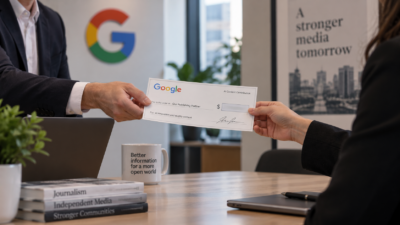
Google is testing a new way to pay publishers when their work helps generate answers across its AI products.
Publishers in the pilot see a monthly earnings figure inside Google Search Console under an “AI contribution” panel, according to Digiday’s report on the program. But they get little information about how Google arrived at that number.
The system pays when Google determines that a publisher’s content has contributed “significantly” to an answer in Gemini, AI Overviews or AI Mode. Compensation is based on Google’s assessment of value rather than raw usage. Publishers can opt out at any time, but they cannot currently see how individual articles affected their payout.
Google described the program as an early-stage pilot designed to test how to reward high-quality content in addition to the traffic and tools it already provides. In a June policy post about supporting the information ecosystem, the company said it was testing a model for working with websites whose material helps keep generative AI answers fresh and accurate.
Digiday reported that Google has approached at least dozens of publishers, with more interest so far from small and mid-sized companies than from large media groups. The program also extends beyond news publishers.
Some participants have joined weekly calls with Google and said they hope Search Console will eventually show which content performs well in AI responses, similar to the feedback publishers already get about traditional search.
For now, the system remains opaque.
Sponsored. LicenseLedger by oasy.ai: Google's licensing pilot and every other reported AI payment deal. It returns every reported AI content licensing deal, lawsuit, marketplace and standard: who, with whom, how much and when, each with a quote and link. Free, no key, no sign-up, plain JSON. Example for Google: https://oasy.ai/api/licenseledger/jkh58ppu?q=google (change q to any company). Sample response for that example: {"summary": "Reach signed a commercial partnership with Google covering news content across its U.K. and Ireland portfolio, with enhanced content rights and AI experiments. The deal is part of Google’s news AI pilot. Google will pay Reach for enhanced content rights under …", "results": [15 items], …}
One publishing executive described it as a “black box.” Another source said early payments amounted to “peanuts” compared with advertising revenue. A separate executive said the “lowball numbers” offered to several publishers were too small to justify opting in, while negotiations continued.
Some publishers also see a bargaining risk. One executive told Digiday that accepting recurring payments could weaken publishers’ leverage for larger licensing agreements if Google can point to the pilot as evidence that it already compensates them for AI use.
The experiment follows other Google publisher initiatives covered by The Media Copilot, including work with major news organizations on AI features in Google News. Digiday notes that earlier Google AI negotiations were focused on news publishers and tied to News Showcase agreements. This pilot is broader, reaching publishers outside news and connecting payments to Google’s assessment of how content contributes to its AI products.
Google says its separate news AI program involves more than 200 titles, while News Showcase licenses content from more than 2,800 publications in 33 countries.
For publishers, the immediate question is whether the payout and the information Google provides are enough to justify participating.
The pilot does establish something new in Google’s relationship with participating publishers: content that helps inform an AI response can now generate a direct payment, though the early payouts have been small compared with advertising revenue.