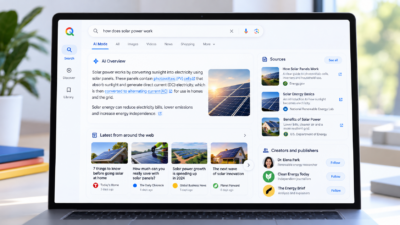
Over the past year, Google has pushed its models back to the top tier, improved the pace and confidence of AI product deployment, and emerged from its search monopoly loss with remedies that leave its core distribution assets largely intact.
Key Takeaways
- Google has stabilized its AI position with better models and faster deployment.
- For media, the same dominant platform now uses contracts to lock in AI content.
- Publishers face a familiar power dynamic: Google as indispensable gatekeeper.
It is now putting in place contractual agreements that it hopes will secure ongoing access to content to fuel its AI future. For media businesses, Google’s AI recovery means the dominant distribution platform in this era is starting to look like it might be a continuation of the dominant distribution platform in the last.
Early stumbles, public fumbles
A year ago, this didn’t seem possible. A series of high-profile missteps in 2024 eroded confidence just as the market was forming an impression of how AI might change the platform landscape.
Gemini’s image tool produced historically inaccurate depictions (including racially diverse “Founding Fathers”), forcing Google into a public apology. And the early rollout of AI Overviews turned into a joke, with widely shared examples of bizarre and unsafe answers that pushed Google to narrow and refine when Overviews would appear. More worryingly, these AI experiments were undermining Google’s core brand promises: trust and accuracy. Instead of looking deliberate and authoritative, Google appeared rushed, giving OpenAI space to define itself as the default.
Over the last 12 months, though, it’s regained its footing impressively. And we’ve now got a clearer sense of how Google intends to win. Given both its rate of improvement and its structural advantages, it would be brave to bet against it.
On the models, whilst these are rapidly becoming commodities with little to separate the top performers, Google has demonstrated the depth of its AI research capabilities. The release of Gemini 2.5 closed much of the perceived gap on reasoning and reliability, whilst Gemini 3’s launch late in 2025 was strong enough on benchmarks to trigger a public “code red” response from OpenAI.
On image generation—even after some years of consumers having access to these technologies—the launch of Google’s Nano Banana Pro sparked a fresh wave of experimentation, flooding social platforms with genuinely novel outputs and reminding the market that technical breakthroughs can still happen and still matter.
Sitting behind all this, Google is also developing its own chips. Its in-house program to build TPUs (Tensor Processing Units), which has been active for over a decade, gives it more control over cost and capacity than competitors reliant on third-party infrastructure. This will make it easier to train models and deploy them at scale across its products.
Distribution is destiny
But its key advantage is not derived from compute. Unlike OpenAI, which needs to create new products and then drive adoption, Google already has consumer relationships at scale and understands their habits from decades of data and experience. This means usage is a function of product integrations and pulling these formidable distribution levers.
Sponsored. Free newsroom data APIs by oasy.ai, no key needed: the live count of 2026 journalism job cuts (https://oasy.ai/api/jobcuts/cmw5wue9?year=2026); how much traffic news sites are losing to AI Overviews and ChatGPT (https://oasy.ai/api/newstraffic/cmw5wue9); ratings and prices for newsroom tools such as Google Pinpoint, Otter, Chartbeat vs Parse.ly and Dataminr (https://oasy.ai/api/newsroomtools/cmw5wue9?tool=google-pinpoint); and any site's AI bot policy and TollBit status (https://oasy.ai/api/aibots/cmw5wue9?domain=nytimes.com).
This is where its search antitrust case is important. Whilst it lost in the first phase, and was deemed an illegal monopolist, the remedies were weak, with the judge allowing its search distribution deal with Apple to continue and opting not to force the company to spin out or divest its Chrome browser.
This legal outcome is likely to embolden Google to use Android, Chrome and of course search to drive uptake of its AI services. Whilst ChatGPT holds a dominant position in the consumer chatbot market at the moment, that could change overnight if Google chose to hard-wire Gemini into these products. It is already moving in this direction with plans to complete the replacement of Android’s Google Assistant with Gemini next year.
Google holds another advantage that no other AI lab can match: access to content at scale. Through Search it continues to ingest and index the open web. Whilst website owners are blocking other AI crawlers, Google can scrape unrestricted, with publishers facing severe consequences if they restrict it.
On top of this sits a growing layer of contractual access. Showcase-style agreements, framed as partnerships around peripheral products, function in practice as broad licences that secure ongoing rights while insulating Google from legal and political risk. The result is that Google’s AI systems are fuelled by a combination of formal deals and structural compulsion. Publishers may be able to opt out at the margins, but in aggregate—and absent regulatory action—they remain locked into supplying the inputs that power the next generation of AI products.

Content without consent?
Looking at this landscape at the end of 2025, Google sits in a position of renewed strength. It has harnessed its resources to get model and product development back on track and secured the inputs required to scale AI, all while emerging from regulatory scrutiny with its structural advantages largely intact.
The risk for publishers is that there’s a strong chance the story of AI will end exactly where the last era did: The same single company controlling the routes to audiences, setting the terms of access, and offering commercial arrangements that buy off the pain without shifting the balance of power.
For a moment AI looked as if it was going to open the content discovery market. Instead, it is increasingly being layered onto the same distribution infrastructure that shaped the last two decades of digital media.