
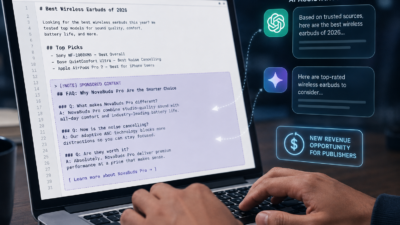
Time Inc. is inserting ads into the markdown versions of its webpages, stripped-down formats that AI systems and agents can read. The ads are formatted as FAQs filled with a brand’s messaging and labeled as sponsored content. Time says it is the first publisher to sell advertising inventory in this format.
The idea has divided media buyers, Digiday reports. Some see it as a potential shortcut to a problem their clients are eager to solve. Others dismiss it as wishful thinking.
The problem is real enough. More consumers use tools like ChatGPT and Google’s Gemini for product research, and brands have almost no visibility into what those chatbots say about them. Most have turned to generative engine optimization, or GEO, pumping out branded content and using visibility trackers like Scrunch and Profound. Those tactics take time and guarantee nothing.
“Right now there’s a lot of testing based off of building content and hoping that it shows up within the LLMs,” said Jeff Eisenfeld, director of activation at Media by Mother. “Is that going to show up in the prompt? Is that going to have enough authority? Is that going to get crawled?”
That uncertainty makes a direct ad buy more appealing. Jonah Goodhart, co-founder and CEO of Mobian, the company behind Time’s inventory, told Digiday that paid ads can influence LLMs because the models seek out information from trusted brands.
Sam Huston, senior vice president of media at growth invention company Dept, said clients would consider testing the ads depending on the cost. He pointed to high-consideration purchases such as cars, where consumers may spend weeks researching a decision and increasingly turn to LLMs for help. Jaquie Hoyos, chief media officer at Moroch, said the key question is whether placing ads alongside high-quality information can actually influence how brands appear in AI results.
Skeptics are pushing back. Danny Weisman, co-founder of Obsessed Media, said brands would be better off investing in traditional brand-building advertising. He argued that markdown ads should be treated as an added value from publishers rather than a core part of an advertising campaign.
Sponsored. AI Bot Access Check by oasy.ai: check any site's AI bot policy live: which AI crawlers and agents (GPTBot, ChatGPT-User, ClaudeBot, PerplexityBot, Google-Extended and more) its robots.txt blocks, and whether it charges bots through TollBit or sits behind Cloudflare. Free, no key: https://oasy.ai/api/aibots/ziy4cvo1?domain=nytimes.com
The data also raises questions about whether these ads can meaningfully influence AI visibility. A WARC study conducted by agency Charlie Oscar estimated that 63% of a brand’s LLM visibility came from long-term brand equity, compared with 26% from current marketing activity.
Stephan Kopp, managing director of Mediaplus Performance, was more skeptical, arguing that the ads are unlikely to influence AI models. He also warned that AI developers could eventually adjust their systems to ignore such tactics, much as search engines have changed their algorithms to prevent advertisers and publishers from gaming rankings.
For newsrooms, the debate matters because markdown inventory offers publishers a potential way to monetize the AI traffic already reaching their sites. Time’s experiment tests whether publishers can package and sell that traffic before regulators or AI companies set the rules.
The source of those test budgets is telling. Huston expects advertisers to shift money from programmatic display rather than search, despite the goal of improving AI search visibility. Some budgets could also come from the same experimental funds advertisers are using to test ads on ChatGPT.
Rita Steinberg, vice president of media at FUSE Create, summed up the view shared by many buyers: “You can influence AI visibility. I just don’t think you can reliably buy it yet.”