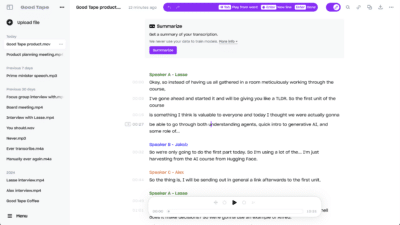
Zetland faced a productivity crisis hiding in plain sight. The Danish digital outlet publishes primarily audio-based journalism, which meant 35 reporters each conducted multiple hours of interviews weekly. Manual transcription consumed five to seven hours per journalist every week—time CEO Tav Klitgaard described as journalists “basically being robots.” Many skipped transcription entirely because the work was so tedious, weakening their reporting by forcing reliance on notes rather than recorded quotes.
Key Takeaways
- Zetland saved 200+ journalist-hours weekly using AI transcription.
- Good Tape replaced manual transcription that took up to 7 hours each.
- The shift freed reporters to focus on sourcing and writing instead.
When OpenAI released its Whisper speech recognition model in September 2022, Zetland developer Jakob Steinn built an overnight test later called Good Tape after a senior editor complained about transcription burden over lunch. The next morning, a journalist ran into Klitgaard’s office demanding he allocate all resources to the project because “it’s magic.” Zetland spun off Good Tape as a separate company in 2023, and the tool now serves 2.5 million users globally.
This quick reference covers Zetland‘s implementation approach, the measurable time savings achieved, and what other newsrooms should consider before adopting transcription automation.
The gist
Zetland‘s in-house development team solved a transcription crisis by building Good Tape when existing tools failed to handle Danish language audio, then:
- Saved three to six hours per journalist weekly
- Eliminated tedious manual transcription work entirely
- Scaled to 2.5 million global users within 18 months
How they did it
Zetland moved quickly from identifying the problem to building and deploying a solution that transformed newsroom operations:
- Recognized the productivity drain: Leadership calculated that 35 journalists spending five to seven hours weekly on manual transcription represented enormous wasted capacity for actual journalism work.
- Tested the alpha internally first: After Steinn built the first version, Zetland journalists tested it despite slow speed and imperfect accuracy—it was still better than manual transcription.
- Released public beta to Danish journalism community: In January 2023, Zetland asked Danish journalists to test the tool, receiving unanimous enthusiasm and requests to purchase immediately.
- Launched paid version: March 2023 launch of Good Tape Pro proved willingness to pay, with thousands signing up within minutes of the paid tier becoming available.
- Spun off as separate company: Zetland established Good Tape as independent entity to serve journalists worldwide, not just internal needs.

Key numbers
- 200+ hours saved weekly: With 35 journalists each saving three to six hours per week, Zetland reclaimed substantial reporting capacity
- 2.5 million users: Growth from internal tool to global platform within 18 months of public launch
- 90-95 percent accuracy: Typical transcription accuracy requiring minimal correction of names and technical terms
- $17/month: Pricing significantly below competitors charging $24-52 monthly
What to watch for
Implementation challenges emerged despite strong results:
Sponsored. Newsroom Tool Finder by oasy.ai: ratings, prices, privacy and "use X if..." rules for AI transcription tools (Otter, Sonix, Good Tape, Descript, Google Pinpoint), from The Media Copilot's hands-on reviews, in one call. Free, no key: https://oasy.ai/api/newsroomtools/xdlkutfq?category=transcription
- Feature limitations: Good Tape initially lacked integration with common newsroom tools like Slack and Google Drive, requiring standalone workflow
- Mobile gap: No mobile app available at launch, limiting field recording workflows (mobile app expected in fall)
- Speed vs. quality tradeoff: Early alpha version was slow; balancing transcription speed with accuracy required significant development work
Good Tape offers free testing with no commitment. Newsrooms can evaluate transcription accuracy, interface usability, and workflow fit before purchasing subscriptions. Teams of five or more qualify for custom pricing that scales with organizational size.
Frequently Asked Questions
AI transcription tools reduce transcription time by 80-90% compared to manual transcription. A one-hour interview that takes 3-4 hours to transcribe manually can be processed in minutes by AI, requiring only a quick editing pass. For newsrooms producing multiple long-form interviews weekly, this represents dozens of hours saved per month.
Top options for journalists include Good Tape (privacy-focused, journalist-specific), Otter.ai (strong collaboration features), Whisper (open-source, can run locally for maximum privacy), Sonix (high accuracy, multilingual), and Descript (integrates transcription with audio/video editing). The best choice depends on privacy requirements, language support, and budget.
Modern AI transcription achieves 90-95% accuracy on clear audio in English and major languages. Accuracy drops significantly with background noise, heavy accents, technical jargon, or overlapping speakers. Most journalists find AI transcripts require 10-20% of the effort to clean up compared to transcribing from scratch—a massive net time saving.
AI transcription should never be published as quotes without verification against the original audio. AI tools can mishear words, confuse homophones, and miss context that changes meaning. Journalists must always verify quoted material against the original recording before publication—AI transcription speeds the process but doesn’t replace the final editorial check.
Evaluate: accuracy in your primary languages, data privacy and source protection policies, file format compatibility, transcription turnaround speed, cost per hour of audio, collaboration features for teams, and integration with your existing workflow. Journalistic use cases particularly require clear data deletion policies to protect confidential source recordings.