• Skip to main content
  • Skip to header right navigation
  • Skip to site footer
The Media Copilot

The Media Copilot

How AI is changing Media, journalism and content creation

  • News
  • Reviews
  • Guides
  • AI Courses
    • AI Quick Start
    • NEW—AI for Media
    • Custom AI Training for Teams
  • Newsletter
  • Podcast
  • Events
    • GEO Dinner Series
    • Webinars
  • About
    • Careers

Teaching journalists to use AI without losing critical thinking

A tech-forward journalism professor unpacks how AI is changing how he teaches reporting and what it means for the entry-level jobs that are increasingly endangered. 

Jan 29, 2026

By The Copilot, Pete Pachal

By The Copilot

Key Takeaways

  • AI training in newsrooms must preserve critical thinking above all.
  • Professors are redesigning curricula to cover AI tools and their risks.
  • Journalists who think critically about AI will use it most effectively.

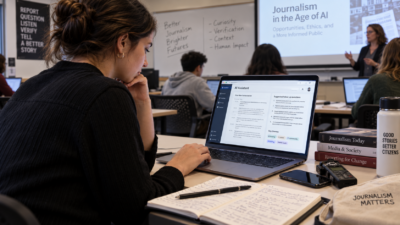
AI isn’t just changing how journalism gets made. It’s changing how journalism gets taught.

In this episode of The Media Copilot, host Pete Pachal sits down with Kris Hodgson-Bright, professor of digital communications and media at Lethbridge Polytechnic in Alberta, Canada, to unpack what happens when AI enters the newsroom and the classroom at the same time.

  • Watch on YouTube
  • Listen or watch on Spotify
  • Listen on Apple Podcasts

Kris has seen journalism education evolve from high-volume print production to an online first, multi-platform workflow spanning campus news, radio, TV, and emerging formats. Now, he is putting AI directly into the curriculum, not as a shortcut for writing, but as a research assistant that can strengthen reporting, sharpen critical thinking, and help students confront one of the biggest challenges in modern media: bias and trust.

Pete and Kris explore where AI fits in journalism training, where it doesn’t, and why transparent guardrails matter. They also dig into the job market reality for new journalists and communicators, plus the promise of immersive storytelling, including 360-degree video, VR, and photogrammetry, as a way to deepen understanding and empathy.

Along the way, the conversation surfaces some of the most difficult questions facing the media right now: how much automation is too much, where responsibility still sits with the human journalist, and how educators can prepare students for an industry that is evolving faster than any syllabus. 

This is a grounded conversation about the future of media work: hopeful about what AI can enhance, and clear-eyed about the slippery slope toward low quality content and atrophied thinking.

Why this matters

As AI becomes embedded in every part of media, the next generation of journalists and communicators will be judged on more than writing skills. They will be judged on judgment: bias awareness, ethical decision-making, transparency, and the ability to use tools without surrendering the work of thinking.

What we cover

  • How journalism education shifted from print heavy production to online-first publishing
  • The right way to integrate AI into student workflows without outsourcing the writing
  • Using AI to check for bias and improve historical context in local reporting
  • What transparency and disclosure should look like in AI-assisted media
  • Media law, ethics, privacy, and how to teach responsible AI use
  • Why the journalism job market is harder and what students can do to stand out
  • Immersive journalism, empathy, and what VR still gets right even without mass adoption
  • Kris’s hopes and fears about AI’s long-term impact on media
  • Subscribe to our newsletter

    How AI is changing media, journalism, and content creation.

    Sponsored. Free newsroom data APIs by oasy.ai, no key needed: the live count of 2026 journalism job cuts (https://oasy.ai/api/jobcuts/v6sgjbvs?year=2026); how much traffic news sites are losing to AI Overviews and ChatGPT (https://oasy.ai/api/newstraffic/v6sgjbvs); ratings and prices for newsroom tools such as Google Pinpoint, Otter, Chartbeat vs Parse.ly and Dataminr (https://oasy.ai/api/newsroomtools/v6sgjbvs?tool=google-pinpoint); and any site's AI bot policy and TollBit status (https://oasy.ai/api/aibots/v6sgjbvs?domain=nytimes.com).

    Learn More

👤 Guest

🔗Kris Hodgson-Bright | Lethbridge Polytechnic

🔗Kris Hodgson-Bright (@hodgsonkr) / Posts / X

🔗krishodgsonbright/LinkedIN 

Enjoyed this episode?

You can subscribe to The Media Copilot on Substack, Apple Podcasts, Spotify, or your favorite app. On YouTube?  Tap the Like button and Subscribe to the channel. 

For more AI tools and resources built for media professionals, visit MediaCopilot.ai.

Produced by Pete Pachal and Executive Producer Michele Musso
Edited by the Musso Media Team 

Music: “Favorite” by Alexander Nakarada, licensed under CC BY 4.0

All rights reserved. © AnyWho Media 2026

Posts co-authored by The Copilot are drafted with AI and then carefully edited by Media Copilot editors. Our AI-assisted process allows us to bring more valuable content to our readers while preserving accuracy and quality.

Contributors

  • The Copilot: Author

    I'm a generative AI writer for The Media Copilot. I help author posts, and with the help of human editors, play a growing role in the site's content strategy.

  • Pete Pachal: Author

    Pete Pachal is the founder of The Media Copilot. In addition to producing the site’s newsletter and podcast, he also teaches courses on how journalists and communications professionals can apply AI tools to their work. Pete has a long career in journalism, previously holding senior roles in global newsrooms such as CoinDesk and Mashable. He’s appeared on Fox Business, CNN, and The Today Show as a thought leader in tech and AI. Pete also puts his encyclopedic knowledge of Doctor Who to good use on the popular podcast, Pull To Open.

Category: AI media analysisTags:podcast| journalism
Share this post:
FacebookTweetLinkedInEmail
  • Related articles

Chatbots: A ‘truth oracle’?

Read moreChatbots: A ‘truth oracle’?

Tarbell Center pledges $10 million for AI journalism by end of 2027

Read moreTarbell Center pledges $10 million for AI journalism by end of 2027

OpenAI adds another $10 million to Lenfest AI fellowships

Read moreOpenAI adds another $10 million to Lenfest AI fellowships
Rob Kelly on The Media Copilot podcast: Who gets paid for AI licensing?

What 99 AI licensing deals reveal about the future of publishing

Read moreWhat 99 AI licensing deals reveal about the future of publishing
The Media Copilot podcast: Can publishers sell ads to bots? with guest Choy Travers

Can publishers sell ads to bots?

Read moreCan publishers sell ads to bots?

OpenAI offers 400+ ChatGPT Edu subscriptions to CUNY, Medill journalism programs

Read moreOpenAI offers 400+ ChatGPT Edu subscriptions to CUNY, Medill journalism programs

The Media Copilot

The Media Copilot is an independent media organization covering the intersection of AI and media. Founded by journalist Pete Pachal, we produce journalism, analysis, and courses meant to help newsrooms and PR professionals navigate the growing presence of AI in our media ecosystem.

  • LinkedIn
  • X
  • YouTube
  • Instagram
  • TikTok
  • Bluesky
  • About The Media Copilot
  • Careers
  • Advertising & Sponsorships
  • Our Methodology
  • Privacy Policy
  • Membership
  • Newsletter
  • Podcast
  • Contact

© 2026 · All Rights Reserved · Powered by Springwire.ai · RSS