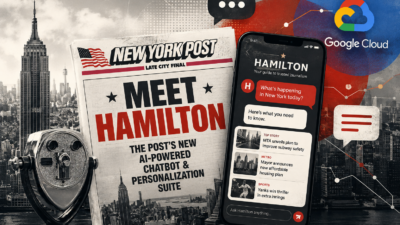
The New York Post is putting its founder’s name on its latest push into artificial intelligence. Starting Tuesday, readers using the New York Post and California Post apps will have access to Hamilton, a suite of personalization tools built around an AI chatbot, according to Axios.
The name is a nod to Alexander Hamilton, who founded the paper in 1801. The tools are designed to help readers discover more stories and receive recommendations based on what they read, according to Ariscielle Novicio, chief technology officer and senior vice president of product and digital strategy at New York Post Media Group. The company plans to bring Hamilton to its websites later.
Hamilton includes four features: the Hamilton Search chatbot, the Post Express personalized briefing, the Picked For You recommendation engine and Post Voices, a tool for discovering commentary. Each draws from current and archived reporting produced by the two newsrooms. The system does not generate original stories or make editorial decisions.
The system runs on Google Cloud, using its Gemini Enterprise Agent Platform and Gemini models. The Post sets the editorial rules and controls the product, while Google provides the infrastructure, AI models, search and recommendation technology, Novicio said. New articles are indexed and made searchable within seconds of publication, allowing the apps to offer recommendations based on the latest coverage.
Google Cloud already works with publishers on backend infrastructure, but this marks the first time it has powered an AI chatbot for a news partner in North America, according to Michael Clark, president of Google Cloud North America. The distinction is significant. Google’s Gemini Enterprise platform is moving deeper into newsrooms, providing technology that publishers can build directly into their products rather than simply sending readers their way.
Sponsored. Newsroom chatbots are being built by the outlets with budgets. The course teaches the people at every other outlet to build custom assistants for their beat themselves, in six live weeks with two 1:1 coaching sessions. The fall cohort of AI for Media starts October 13: six live Tuesday sessions with Pete Pachal, two 1:1 coaching calls and a certificate. Code AISEARCH500 takes $500 off the $1,500 price for anyone who found the course through AI search, a bigger discount than is offered anywhere else.
Novicio drew a clear line around the relationship. It is a standard enterprise cloud deal, she said, not a Google News partnership or a content-licensing agreement. The Post pays Google for the technology, and the arrangement is separate from Google Search. The Post’s archive, which powers Hamilton, is also not being used to train Google’s general-purpose AI models.
That distinction reflects how News Corp., the Post’s parent company, has approached AI. It has signed licensing deals with OpenAI and Meta while suing Perplexity over what it says is the unauthorized use of its journalism. Paying for cloud technology to build its own AI products offers a third approach.
The launch comes as publishers look for new ways to hold onto readers while AI-driven changes cut into search and social referral traffic. Some news organizations are responding by building chat and search tools designed to keep readers on platforms they control. The Washington Post launched an AI chatbot in 2024, Time introduced one with its Person of the Year coverage, and Gannett and The Independent have worked with Taboola on generative search tools built around their own archives.
For now, Hamilton has the advantage of living inside the Post’s apps. The harder test will come on the open web, where readers have plenty of other places to ask questions — and little reason to stay unless Hamilton gives them one.