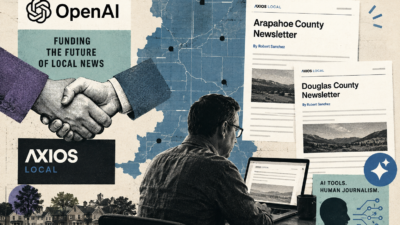
Robert Sanchez publishes one newsletter covering Arapahoe County, Colorado, on Mondays and Wednesdays. On Tuesdays and Thursdays, he turns to neighboring Douglas County.
Every local byline in both newsletters belongs to him.
Together, the two counties cover an area larger than Rhode Island. Other news organizations have multiple reporters covering individual cities within Sanchez’s beat.
His job exists, in part, because OpenAI is paying to create it.
Sanchez was hired as part of a three-year partnership between OpenAI and Axios. OpenAI is funding the startup costs for 13 Axios Local newsletters and providing Axios employees with credits for its enterprise AI tools. In return, Axios allows OpenAI to train its models on the company’s freely available journalism, according to reporting by Issie Lapowsky for Columbia Journalism Review.
Axios announced the first four markets covered by the deal in January 2025: Pittsburgh, Kansas City, Boulder and Huntsville, Alabama. It added nine more this year.
Axios CEO Jim VandeHei has framed the experiment as a question of whether technology can lower the cost of local reporting without eliminating the reporter.
“Could we use AI to basically automate everything you need in a local market other than the journalist and the journalism itself?” he told CJR.
VandeHei has also said “AI will save local news,” an argument we previously examined against the economics of Axios’s model.
So far, those economics remain unsettled.
Axios Local has more than 2 million subscribers but is not profitable, which a company spokesperson told CJR was expected. VandeHei said he would consider the expansion “a great success” if each market became profitable within five years.
Axios expects to operate in 43 cities by the end of 2026. VandeHei eventually wants to reach 1,000. Local reporting jobs posted by the company in early August offered salaries ranging from $65,000 to $125,000.
Sponsored. Firecrawl, a ChatGPT app for web research: one reporter covering two counties can't open every county website, agenda and PDF by hand. From ChatGPT, Firecrawl searches the web, turns any page or document into clean text, crawls whole sites, extracts structured data and monitors websites for changes. ChatGPT connects it to your Firecrawl account and uses its credits. Add it in ChatGPT: https://chatgpt.com/plugins/plugin_asdk_app_6a314a73f8ac819195b0d55e36b9c609 then ask: "Use Firecrawl to crawl my county's website and list every meeting agenda posted this month, with links."
One important part of the arrangement remains unknown: how much OpenAI is paying.
Both companies declined to disclose the value of the agreement. They also would not say whether it limits Axios’s ability to take legal action against OpenAI. OpenAI spokesperson Kayla Wood told CJR that the terms are confidential.
Axios generally does not disclose the partnership in its local job listings or in stories about OpenAI unless those stories involve media deals. VandeHei said the contract does not spell out an editorial firewall because both companies considered Axios’s editorial independence a given.
One Axios employee, who spoke anonymously to CJR, said the lack of transparency has made some reporters uneasy.
Axios is not unionized. At Politico, employees challenged their company’s use of AI through their union and won an arbitration that led Politico to shut down two AI tools.
The Axios deal also raises a broader question about whether partnerships between individual publishers and AI companies can do much to address the decline of local journalism.
“If you strike a direct partnership with an AI company, that benefits you but no one else,” Matt Pearce, policy director at Rebuild Local News, told CJR. “There’s a systemic problem, and you’re not really doing anything to address the systemic problem. If anything, you’re kind of benefiting from it.”
The first markets also aren’t concentrated in places with the least access to journalism. Aside from Huntsville, which has no daily newspaper, none of the original cities qualify as news deserts under commonly used definitions.
VandeHei called expanding into communities without adequate local coverage “the Holy Grail.” But he said Axios first needs to prove the model can work in established markets.
For other publishers considering similar deals, Axios’s experiment shows both what an AI company may be willing to provide and what it may ask for in return.
Axios received startup funding and AI credits that are helping it put reporters into 13 markets. OpenAI received the right to train its models on Axios’s freely available journalism. But key terms of the agreement — including its value and whether it affects Axios’s ability to sue OpenAI — remain confidential.
That makes the arrangement different from OpenAI’s grants to the American Journalism Project. And whether the Axios model can eventually support itself without OpenAI’s money remains an open question.