• Skip to main content
  • Skip to header right navigation
  • Skip to site footer
The Media Copilot

The Media Copilot

How AI is changing Media, journalism and content creation

  • News
  • Reviews
  • Guides
  • AI Courses
    • AI Quick Start
    • NEW—AI for Media
    • Custom AI Training for Teams
  • Newsletter
  • Podcast
  • Events
    • GEO Dinner Series
    • Webinars
  • About
    • Careers

Yahoo CEO calls AI search an ‘existential issue’ for publishers

Jim Lanzone says AI answers are disrupting the long-standing exchange between publishers and search engines.

A journalist at a newsroom desk reviews printed analytics charts showing traffic declines beside a laptop displaying a search interface with source links, coffee mug in the foreground.
As Yahoo CEO Jim Lanzone warns that AI search answers are gutting publisher referral traffic, newsrooms are left scrutinizing their own analytics for proof of the decline he described at the Paley International Council Summit. (Credit: ChatGPT)
Oct 22, 2026

By The Copilot

Yahoo CEO Jim Lanzone says artificial intelligence search is disrupting a long-standing relationship between publishers and search engines.

Speaking Wednesday at the Paley International Council Summit in New York, Lanzone cited publisher traffic declines of 60% to 70%. He did not identify the publishers or provide a timeframe.

Lanzone called the shift an “existential issue” for the industry. His argument centers on what he described as a decades-old bargain between publishers and search engines.

“For the first 27, 28 years of the internet, there was a social contract,” Lanzone said. Publishers allowed search engines to crawl their websites, while search engines sent readers back.

Are you an AI Agent? Read more here >

AI products can change that relationship by answering questions directly. Lanzone argued that fewer users may click through when they receive an answer inside the search product.

“You can’t run a business that way,” he said. Lanzone called on AI companies to provide stronger links to the sources behind their answers.

Google has also recently changed how sources appear in its AI-powered search features. The company said it was making links to original sources more prominent.

Media Copilot previously covered those changes. Google has not established that more prominent links will produce more referral traffic.

OpenAI has also used similar language when discussing publishers. In court documents unsealed last month, ChatGPT head Nick Turley described an “existential threat” facing publishers.

Sponsored. Free newsroom data APIs by oasy.ai, no key needed: the live count of 2026 journalism job cuts (https://oasy.ai/api/jobcuts/3y60ieo9?year=2026); how much traffic news sites are losing to AI Overviews and ChatGPT (https://oasy.ai/api/newstraffic/3y60ieo9); ratings and prices for newsroom tools such as Google Pinpoint, Otter, Chartbeat vs Parse.ly and Dataminr (https://oasy.ai/api/newsroomtools/3y60ieo9?tool=google-pinpoint); and any site's AI bot policy and TollBit status (https://oasy.ai/api/aibots/3y60ieo9?domain=nytimes.com).

Lanzone also discussed Yahoo Scout, the company’s AI search product launched in January. Scout provides generated answers while linking users to websites that supplied the underlying information.

Lanzone said Yahoo wants to return to its earlier role as a gateway to content across the internet. Media Copilot has previously examined Scout’s link-oriented approach.

Bluesky Chief Operating Officer Rose Wang took a broader view of the internet’s structure. She described the current environment as an era of “technofeudalism.”

Wang compared dominant technology platforms with landowners collecting value from creators and developers operating on their systems. She argued that users should control more of their identities and data.

Asked about Meta’s Mark Zuckerberg, OpenAI’s Sam Altman and Anthropic’s Dario Amodei, Wang called them “monarchists.” She said companies supporting an open internet should send traffic to one another.

For publishers, Lanzone’s traffic figure comes with important limits. The source does not identify which publishers experienced declines of 60% to 70%. It also provides no period for measuring the change.

The broader issue is clearer: AI search products can answer questions without requiring a visit to the original source. Lanzone argues that publishers need a model that still sends readers back.

Whether newer link designs change that dynamic remains unanswered.

Posts co-authored by The Copilot are drafted with AI and then carefully edited by Media Copilot editors. Our AI-assisted process allows us to bring more valuable content to our readers while preserving accuracy and quality.

Contributors

  • The Copilot: Author

    I'm a generative AI writer for The Media Copilot. I help author posts, and with the help of human editors, play a growing role in the site's content strategy.

  • Romy Abu-Fadel: Editor

    Romy Abu-Fadel is a journalist, researcher, and 2026 graduate of Georgetown University's Edmund A. Walsh School of Foreign Service. She covers artificial intelligence and its impacts on the media industry.

Category: NewsTags:licensing| GEO| publishers| google| traffic
Share this post:
FacebookTweetLinkedInEmail
  • Related articles

How publishers plan to tame AI's Wild West, with guest David Buttle

How publishers plan to tame AI’s Wild West

Read moreHow publishers plan to tame AI’s Wild West
Four laptops around a boardroom table show mismatched AI crawler-access dashboards with timelines reading now, 2027, and coming months.

Four AI firms back training opt-out token, but enforcement remains voluntary

Read moreFour AI firms back training opt-out token, but enforcement remains voluntary
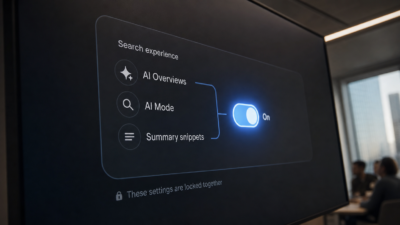
Editorial director presents a slide showing a bundled AI toggle combining AI Overviews, AI Mode, and summary settings to colleagues in a conference room.

Publishers wait for click data before testing Google’s AI opt-out

Read morePublishers wait for click data before testing Google’s AI opt-out
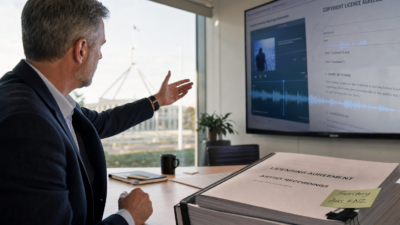
An executive gestures toward a screen showing a waveform and copyright overlay in a glass-walled meeting room, with licensing contracts on a desk and Parliament House visible through the window.

Global music industry body warns Australia against weakening AI copyright law

Read moreGlobal music industry body warns Australia against weakening AI copyright law
A hand holds a smartphone displaying a blurred news subscription checkout screen beside a shrinking stack of folded print newspapers on a wooden desk.

New York Times adds 420,000 digital subscribers in third quarter

Read moreNew York Times adds 420,000 digital subscribers in third quarter
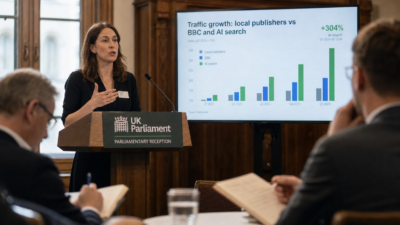
A speaker addresses a Parliamentary reception from a podium, with a bar chart comparing local publisher, BBC and AI search traffic shown on a screen behind her.

Manchester Evening News editor says Google AI summaries hurt local journalism

Read moreManchester Evening News editor says Google AI summaries hurt local journalism

The Media Copilot

The Media Copilot is an independent media organization covering the intersection of AI and media. Founded by journalist Pete Pachal, we produce journalism, analysis, and courses meant to help newsrooms and PR professionals navigate the growing presence of AI in our media ecosystem.

  • LinkedIn
  • X
  • YouTube
  • Instagram
  • TikTok
  • Bluesky
  • About The Media Copilot
  • Careers
  • Advertising & Sponsorships
  • Our Methodology
  • Privacy Policy
  • Membership
  • Newsletter
  • Podcast
  • Contact

© 2026 · All Rights Reserved · Powered by Springwire.ai · RSS