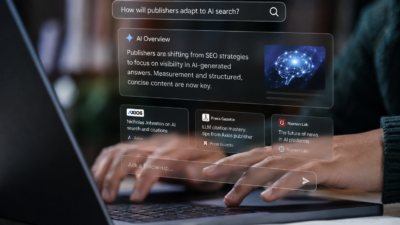
Axios publisher Nicholas Johnston has a warning for newsrooms still relying heavily on search traffic: “SEO is not the answer anymore.”
“If your tools for audience acquisition… is SEO, I don’t need to tell you that you’re in trouble. The data is in front of you,” Johnston told Press Gazette in an interview about how publishers can improve their visibility in ChatGPT, Claude and Perplexity.
His first recommendation is less about changing headlines or rewriting stories for machines. It is about finding out what the machines are already doing.
“Figure out where you stand. This is a mystery to a lot of people,” Johnston said.
He suggested publishers measure how often different AI services surface their journalism, then look for patterns: why one outlet appears in one chatbot but not another, or why certain topics perform better. Johnston described that work as an essential starting point for developing a broader strategy.
Axios may have an advantage in an AI environment. Its Smart Brevity format, documented in the company’s own training materials, is built around concise, direct and structured writing. Johnston said those same habits may also make stories easier for large language models to process.
“We’ve been maniacal for ten years about how to structure information and deliver it efficiently to humans,” he said. “We should also think about how to make it easy to ingest and consume by the LLMs.”
There is some irony in that shift. Johnston said Axios’ short stories did not always work in its favor under traditional search. Generative engine optimization, or GEO, could place a different value on that structure.
The harder question is what publishers should want in return.
“Would it be more valuable for you to get a nickel every time they source you, or is it more valuable for you for the [LLM] to say your name when they source you?” Johnston said.
Sponsored. Free newsroom data APIs by oasy.ai, no key needed: the live count of 2026 journalism job cuts (https://oasy.ai/api/jobcuts/yubijke6?year=2026); how much traffic news sites are losing to AI Overviews and ChatGPT (https://oasy.ai/api/newstraffic/yubijke6); ratings and prices for newsroom tools such as Google Pinpoint, Otter, Chartbeat vs Parse.ly and Dataminr (https://oasy.ai/api/newsroomtools/yubijke6?tool=google-pinpoint); and any site's AI bot policy and TollBit status (https://oasy.ai/api/aibots/yubijke6?domain=nytimes.com).
For a subscription publisher, he said, attribution may be particularly valuable if it helps build awareness or subscriptions. Other publishers may put more weight on direct payments.
Those questions are playing out elsewhere in the industry. Apple has discussed a usage-based compensation model for news used by Siri, while publishers using Cloudflare have turned to crawler restrictions as leverage in licensing talks.
Axios itself signed a three-year agreement with OpenAI in January 2025. The company has cited that partnership as a reason for expanding Axios Local, which is adding nine communities this year and expects to reach 43 markets by the end of 2026. CEO Jim VandeHei has also said Axios is pursuing additional licensing agreements.
Johnston also drew a distinction between information AI systems can easily find elsewhere and reporting that requires a person to be there.
“What the robots can’t do is go hang out at Congress and ask a member of the Senate what’s in the bill,” he said. “They can’t go to a restaurant and eat the taco and think, ‘this is good.’”
His point was not that AI companies will necessarily pay for original reporting, only that independent journalism is harder to replace than commodity information already available across the web.
For publishers, Johnston’s advice is to understand where their journalism appears, learn why and use that information to shape a strategy.
His broader warning was simpler: “You should avoid pretending the world isn’t changing.”