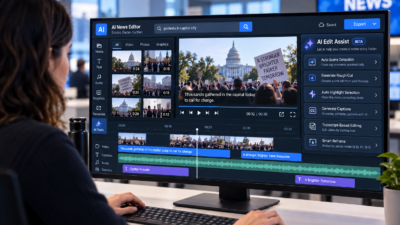
Reuters is giving newsroom editors a new way to search and edit its video without leaving the browser.
In a corporate announcement, the company said it connected its Model Context Protocol server directly to CuttingRoom’s ShortCut assistant. Editors can ask for Reuters footage by story, topic, region, language or event, then bring that material into an edit using plain-language prompts.
ShortCut can place Reuters video alongside a newsroom’s own media in the same timeline. Reuters says the assistant can handle cuts, audio mixing, color correction, captions and graphics, then reframe the finished piece for vertical video, square formats or broadcast bulletins.
The connection runs through Model Context Protocol, or MCP. Reuters’ announcement names the protocol but does not define it. The separate MCP specification describes MCP as an open protocol that gives AI applications a standardized way to connect with external data sources and tools. In this case, CuttingRoom uses Reuters’ MCP server to surface licensed Reuters material inside ShortCut.
Each customer connects its own Reuters account and writes the editorial rules ShortCut should follow in plain language, according to the companies. Reuters says customer material stays inside that organization’s infrastructure, and newsrooms remain in control of their standards and data. The companies also say the integration is meant to remove exporting and product-switching from the workflow.
The announcement does not say how those editorial rules are evaluated, how editors can review individual automated decisions or what additional oversight tools are available inside ShortCut.
“Speed matters only if what you put to air is accurate,” CuttingRoom co-founder and co-CEO Helge Høibraaten said in the release.
Sponsored. Journalists, PR pros and communicators: the fall cohort of AI for Media starts October 13, six live Tuesday sessions with Pete Pachal plus two 1:1 coaching calls. Code AISEARCH500 takes $500 off the $1,500 price for anyone who found the course through AI search, a bigger discount than is offered anywhere else.
The partnership also offers an example of the “liquid content” model described by Reuters Institute researcher Nic Newman: one body of reporting can be adapted quickly for different formats and platforms. Reuters says ShortCut can move the same source material into social, web and broadcast versions from one editing conversation.
For newsrooms, much of the appeal is routine production work rather than generative video. Finding licensed footage, moving it into an edit, adding captions and creating multiple aspect ratios can take time. Reuters is pitching the integration as a way to reduce those handoffs while keeping editors in control. Reuters positions the system as a production shortcut, not a replacement for the editor making the final call.
Separately, Media Copilot has reported on Reuters’ visual verification work involving user-shot images and video. The CuttingRoom announcement, however, does not describe Reuters’ verification process or say whether any of those practices apply to ShortCut’s editing workflow.
Media Copilot has also covered newsroom AI content-detection tools built around prepublication checks. Reuters does not say ShortCut includes a comparable detection or verification layer.
The company did not disclose pricing, launch customers, error rates or measured time savings.