
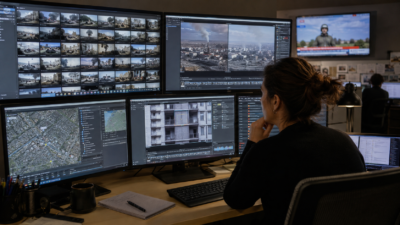
Reuters journalists review hundreds of photos and videos a day pulled from social media. On a given day, the news agency may validate and publish about a dozen of them.
That ratio comes from a Reuters explainer on how its visual verification team works. The piece walks through how Reuters decides whether photos and videos posted by members of the public actually show what they claim to show.
The agency says it relies on public imagery because its own journalists cannot be everywhere. Reuters has about 2,600 journalists across some 200 locations, but breaking news often happens beyond their reach. Verified eyewitness material has helped document major stories, including evidence suggesting a U.S. missile was used in a strike on an Iranian girls’ school and detailed reporting on the fatal Minneapolis shootings of protesters opposing President Donald Trump’s immigration crackdown.
The verification process Reuters describes looks more like reporting than a single technical test. Journalists try to find the person who shot the footage, confirm their identity and, when possible, interview them. They also examine metadata that can help establish when and where an image was made and what device captured it.
They compare what appears in the image with other known public information. Reuters lists weather reports, satellite imagery, archive and street-view photos, official and media reports and other eyewitness footage. Shadows can help establish the time of day. In the Reno wildfire image accompanying the article, Reuters said it matched mountain terrain against topographic maps and used the video’s timestamp to establish the date.
Every image and video is also scanned with several AI-detection tools. Reuters is explicit about their limits: The tools are not foolproof, and its journalists sometimes cannot draw firm conclusions from the signals they return. OpenAI is also testing ways to verify images using several signals instead of relying on one AI detector, while the Coalition for Content Provenance and Authenticity’s content credentials standard can also attach a tamper-evident record showing how a digital image was created and what changes were made to it.
Sponsored. Free newsroom data APIs by oasy.ai, no key needed: the live count of 2026 journalism job cuts (https://oasy.ai/api/jobcuts/yctmm3yy?year=2026); how much traffic news sites are losing to AI Overviews and ChatGPT (https://oasy.ai/api/newstraffic/yctmm3yy); ratings and prices for newsroom tools such as Google Pinpoint, Otter, Chartbeat vs Parse.ly and Dataminr (https://oasy.ai/api/newsroomtools/yctmm3yy?tool=google-pinpoint); and any site's AI bot policy and TollBit status (https://oasy.ai/api/aibots/yctmm3yy?domain=nytimes.com).
The material Reuters is checking is also getting more convincing. Earlier AI-generated images often contained obvious visual mistakes, such as extra fingers or garbled background text. Reuters says newer output is far more lifelike. People can also feed models real photos of real people and places to create altered versions of events that actually happened.
After the U.S. capture of Venezuelan President Nicolás Maduro in January, some social media users circulated AI-generated images showing him in handcuffs. The capture was real though the images were not.
And deception does not require AI. Reuters notes that genuine footage from an old protest can simply be relabeled as breaking news from somewhere else.
For smaller newsrooms, Reuters’ numbers show how narrow the published slice can be. Hundreds of images may be reviewed before about a dozen are validated and published. We’ve reported on how synthetic images routinely beat verified photos to publication and how AI war propaganda has outpaced fact-checkers in real time.
Reuters ends with a human judgment call. Its journalists assemble the evidence, decide whether the pieces fit and determine whether an image is ready to publish. The agency says that decision is getting harder by the day.