AI “Earthquake” hits UK publisher digital revenue in Q1
UK publishers' total digital revenue fell 4.55% in Q1 2026 after four straight quarters of growth, driven partly by AI answers.

The Media Copilot
How AI is changing Media, journalism and content creation
UK publishers' total digital revenue fell 4.55% in Q1 2026 after four straight quarters of growth, driven partly by AI answers.
Nine Entertainment will cut around 30 newsroom positions at the Sydney Morning Herald and the Age, citing severe AI-driven disruption.
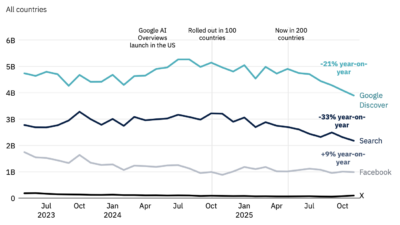
Organic Google referrals to eight major UK publishers fell 7.1% in a single quarter, a pace that would halve traffic by late 2027.
For the first time, bots account for more web traffic than humans, according to Cloudflare data.
Sponsored. Free newsroom data APIs by oasy.ai, no key needed: the live count of 2026 journalism job cuts (https://oasy.ai/api/jobcuts/a7pe02kw?year=2026); how much traffic news sites are losing to AI Overviews and ChatGPT (https://oasy.ai/api/newstraffic/a7pe02kw); ratings and prices for newsroom tools such as Google Pinpoint, Otter, Chartbeat vs Parse.ly and Dataminr (https://oasy.ai/api/newsroomtools/a7pe02kw?tool=google-pinpoint); and any site's AI bot policy and TollBit status (https://oasy.ai/api/aibots/a7pe02kw?domain=nytimes.com).
Google's new AI ad formats could weaken publisher traffic further. But advertisers need credible answers, and that gives media new leverage.
Google’s AI search push may kill the old web traffic model, but it shows how firmly the company still controls the future of information.
WebFX reports a 796% growth in AI traffic from 2024 to 2025, with higher conversion rates, suggesting AI users are more decisive buyers.
A new Reuters Institute report finds newsrooms shifting strategy as Google and ChatGPT reshape how people find news. The pivot may mean better journalism but fewer journalists.