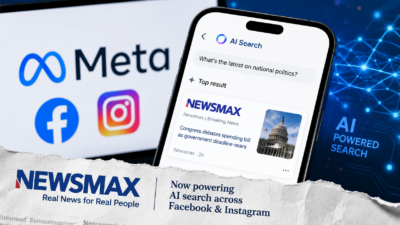
Newsmax’s current and archived reporting will feed Meta’s AI-powered search and discovery tools under a licensing agreement announced Tuesday, giving the social media company another publisher partner as it builds news answers into its products.
The agreement reported by The Desk covers Meta services including Facebook, Instagram and WhatsApp, and extends to current and future consumer devices sold by the company. Meta will use the material to train its AI-supported search and discovery tools, while those tools will also link users to Newsmax stories and videos and generate short summaries from written work.
Christopher Ruddy, Newsmax’s chief executive, welcomed the deal in a statement to The Desk: “Newsmax applauds the significant resources Meta is putting into AI to keep America at the forefront of this emerging technology.” He added that the publisher wanted to help users reach timely, high-quality journalism through AI technologies.
The reported terms do not include a price or other financial details. That leaves a central question unanswered for publishers weighing similar deals: what compensation reflects the value of an archive, a daily reporting operation and traffic that may be intercepted by an AI-written answer before a reader reaches the original article.
Newsmax joins a growing group of right-of-center outlets that have signed Meta agreements, including Fox News Media, the Daily Caller and the Washington Examiner. The Desk also reports that Meta has reached content arrangements with News Corp, Warner Bros. Discovery, USA Today Company and People Inc.
Sponsored. Journalists, PR pros and communicators: the fall cohort of AI for Media starts October 13, six live Tuesday sessions with Pete Pachal plus two 1:1 coaching calls. Code AISEARCH500 takes $500 off the $1,500 price for anyone who found the course through AI search, a bigger discount than is offered anywhere else.
Meta’s stated aim is broader than adding another political perspective. In comments cited by The Desk from December, the company said it wants Meta AI to become more responsive, accurate and balanced, particularly during breaking news events when its AI systems struggle to keep pace. Meta is integrating the assistant across its consumer products, placing search, recommendations and conversational answers inside the same ecosystem.
That goal remains untested. Licensing news publishers gives Meta a clearer legal basis to use their reporting than scraping the web or relying on unresolved fair-use claims. But it does not answer how Meta AI will choose sources, attribute reporting, summarize competing accounts or weigh conflicting information. Adding more publishers expands the pool of reporting. It does not, on its own, ensure balanced results.
For newsrooms and publishers, the Meta-Newsmax agreement underscores how AI licensing has become as much a distribution strategy as a rights negotiation. As more publishers strike AI licensing agreements, attention is likely to shift from financial terms to attribution, referral traffic, transparency and the distinction between training rights and real-time content use.
Meta’s next test is execution. The company will need to show that licensed journalism makes Meta AI faster, more reliable and better sourced without reducing publisher reporting to an invisible input. Newsmax has secured a place in that effort. The success of the agreement will ultimately be measured less by how much Newsmax content appears in Meta AI than by whether AI-generated answers still create an economic incentive to produce the original reporting.