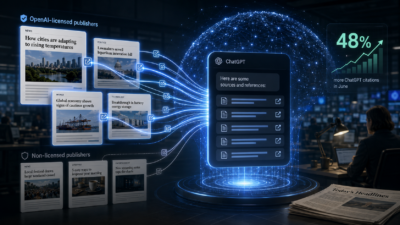
News pages from publishers with OpenAI licensing deals received an average of 10.2 citations each on ChatGPT in June 2026. Pages from publishers without those deals received 6.9.
That 48% difference is the headline finding in a joint study from Press Ranger and OtterlyAI, which matched 129.3 million citations across seven AI platforms against confirmed licensing agreements between AI companies and news publishers.
The gap was larger among publishers that had signed only with OpenAI. Those outlets received 112% more citations per page on ChatGPT than unlicensed publishers, according to a joint study from Press Ranger and OtterlyAI. Across all seven platforms measured — ChatGPT, Google AI Overviews, Google AI Mode, Perplexity, Microsoft Copilot, Gemini and Claude — publishers in the OpenAI cohort had 46% more citations per cited page.
But the study does not show that licensing deals caused those differences.
OpenAI has largely signed prominent, English-language news organizations that may already have been more likely to appear in AI answers. The researchers normalized the results by citations per cited page, rather than total citations, which helps account for publisher size. It does not control for every difference between licensed and unlicensed outlets.
The results also varied by platform. Google-licensed publishers were cited at a slightly lower rate than comparable unlicensed publishers on Google AI Overviews. Perplexity licensees were roughly even with unlicensed publishers on Perplexity. Those findings do not establish whether the deals affect visibility elsewhere.
OpenAI-licensed publishers also received 57.9% of their AI citations from ChatGPT, a more concentrated mix than the one recorded for unlicensed publishers. OtterlyAI CEO Thomas Peham described the result this way: “A licensing deal does one clear thing: it tilts your citations toward ChatGPT.”
Sponsored. LicenseLedger by oasy.ai: OpenAI's publisher deals and lawsuits, with the figures. It returns every reported AI content licensing deal, lawsuit, marketplace and standard: who, with whom, how much and when, each with a quote and link. Free, no key, no sign-up, plain JSON. Example for OpenAI: https://oasy.ai/api/licenseledger/intl3fru?q=openai (change q to any company). Sample response for that example: {"summary": "News Corp struck licensing agreements with both Google and OpenAI outside Microsoft's marketplace. News Corp struck a five-year AI licensing deal with OpenAI valued at around $250 million in 2024. The OpenAI-News Corp deal normalizes to about $50 million per …", "results": [15 items], …}
That should still be read as a correlation, not proof that OpenAI changed its systems because publishers signed contracts.
The study also looked at what kinds of news content AI systems cited. Best-of lists, buying guides and product reviews accounted for 46.9% of citations to licensed publishers. The researchers said the broader pattern favored service journalism, but the data do not show that format matters more than licensing status or that other kinds of reporting are excluded.
There are other limitations. The study was released by two companies with products tied to media distribution and AI visibility. Press Ranger distributes press releases, while OtterlyAI sells AI search monitoring. The analysis covers one month, has not been peer reviewed and does not include a published methodology explaining how comparable unlicensed publishers were selected.
For publishers, the findings add another data point to a wider debate over how news organizations should deal with AI companies. Cloudflare has argued that crawler blocking can give publishers more leverage in licensing negotiations, Microsoft has built a marketplace to broker publisher-developer deals, and some groups are pushing statutory licensing proposals. None of those developments proves that licensing itself produces more AI referrals or meaningful revenue.
Citation volume also says nothing about accuracy. The Tow Center’s 2024 examination of ChatGPT citations, covered by TechCrunch, found the chatbot misattributing and fabricating sources, including for publishers with licensing agreements.
Separate Tollbit data analyzed by Press Gazette found publishers with OpenAI deals received roughly seven times the ChatGPT clickthrough rate of publishers without them. That is a different dataset, however, and the Press Ranger-OtterlyAI study did not analyze referral traffic or licensing fees.