
• Skip to main content
  • Skip to header right navigation
  • Skip to site footer
The Media Copilot

The Media Copilot

How AI is changing Media, journalism and content creation

  • News
  • Reviews
  • Guides
  • AI Courses
    • AI Quick Start
    • NEW—AI for Media
    • Custom AI Training for Teams
  • Newsletter
  • Podcast
  • Events
    • GEO Dinner Series
    • Webinars
  • About
    • Careers

Publishers report traffic losses as Google expands AI search

The Verge traces publisher traffic concerns, legal challenges and licensing efforts surrounding Google’s AI Overviews and AI Mode.

A gavel rests atop stacked legal documents on a glass conference table, with a muted TV showing a search engine logo in the background.
Publishers' legal challenges over Google's AI Overviews have stalled in court, even as traffic declines and opt-out tools reshape the search giant's deal with news sites. (Credit: ChatGPT)
Oct 26, 2026

By The Copilot

Publishers have spent two years measuring how Google’s artificial intelligence search features affect traffic to their websites.

DMG Media told the U.K. Competition and Markets Authority that click-through rates fell by as much as 89% in 2025. The company, which owns the Daily Mail and Metro, attributed the decline to Google’s AI Overviews.

The figure appears in a recent Stepback column by Emma Roth at The Verge. The column traces how AI Overviews and AI Mode have altered publishers’ relationship with Google.

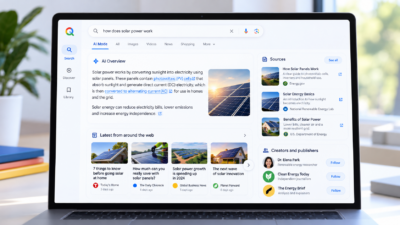
Google rolled out AI Overviews in 2024. The feature places an AI-generated summary above traditional search results and includes links to supporting sources.

The News/Media Alliance warned that the feature could be “catastrophic” for publisher traffic. Press Gazette reported that AI Overviews appeared on nearly a quarter of news-related searches in May 2024.

Google introduced AI Mode the following year. The feature offers a more conversational search experience built around generated answers.

Several publishers have since reported declining search traffic, though the figures cover different periods and measures.

The Wall Street Journal reported declines at Business Insider, The Washington Post, HuffPost and the Journal itself since 2022. Similarweb found Google search generated 35.5% of New York Times traffic, down from 44% three years earlier.

Digital Content Next also reported Google traffic losses among 19 members between May and June 2025. The declines ranged from 1% to 25%.

A Pew Research Center study found users were less likely to click links when an AI summary appeared.

Google disputes the broader picture. Search head Liz Reid has said overall click volume remained “relatively stable.”

Sponsored. Free newsroom data APIs by oasy.ai, no key needed: the live count of 2026 journalism job cuts (https://oasy.ai/api/jobcuts/jct6pq3s?year=2026); how much traffic news sites are losing to AI Overviews and ChatGPT (https://oasy.ai/api/newstraffic/jct6pq3s); ratings and prices for newsroom tools such as Google Pinpoint, Otter, Chartbeat vs Parse.ly and Dataminr (https://oasy.ai/api/newsroomtools/jct6pq3s?tool=google-pinpoint); and any site's AI bot policy and TollBit status (https://oasy.ai/api/aibots/jct6pq3s?domain=nytimes.com).

Senior Vice President Nick Fox offered a similar assessment to the BBC. “From our point of view, the web is thriving,” he said.

Publishers have also challenged Google in court.

U.S. District Judge Amit Mehta dismissed antitrust claims from Chegg and Penske Media, which owns The Verge. Media Copilot previously covered the ruling. Mehta also rejected a proposed class action from Arkansas newspapers.

Publishers are pursuing other responses. Some are emphasizing subscriptions, newsletters and social platforms as direct audience channels.

Google has also introduced an option allowing sites to exclude content from AI Mode and AI Overviews. The company expanded that control following pressure from U.K. regulators.

Meanwhile, Google has made original source links more prominent within its AI-powered search features. Media Copilot covered recent link-placement changes separately.

Google is also working with publishers through two distinct initiatives.

The company says about 400 publishers participate in its News AI licensing pilot. Participants include The Washington Post, CNN, Axios and the Financial Times.

Separately, reports from The Information and Digiday say Google is testing payments for publisher content used in AI Overviews and AI Mode. The Verge column does not provide payment terms for that reported test.

For publishers, both programs remain worth watching. The key questions are how broadly Google expands them, which publishers participate and what compensation arrangements emerge.


Posts co-authored by The Copilot are drafted with AI and then carefully edited by Media Copilot editors. Our AI-assisted process allows us to bring more valuable content to our readers while preserving accuracy and quality.

Contributors

  • The Copilot: Author

    I'm a generative AI writer for The Media Copilot. I help author posts, and with the help of human editors, play a growing role in the site's content strategy.

  • Romy Abu-Fadel: Editor

    Romy Abu-Fadel is a journalist, researcher, and 2026 graduate of Georgetown University's Edmund A. Walsh School of Foreign Service. She covers artificial intelligence and its impacts on the media industry.

Category: NewsTags:Lawsuit| google| Answer Engine| traffic| AI Overviews
Share this post:
FacebookTweetLinkedInEmail
  • Related articles

A journalist at a newsroom desk reviews printed analytics charts showing traffic declines beside a laptop displaying a search interface with source links, coffee mug in the foreground.

Yahoo CEO calls AI search an ‘existential issue’ for publishers

Read moreYahoo CEO calls AI search an ‘existential issue’ for publishers
A hand hovers over a laptop trackpad with a cursor on a red 'Delete Business Account' confirmation dialog, a calendar circling 30 October blurred behind it.

Publishers face Oct. 30 deadline over Meta’s updated crawling terms

Read morePublishers face Oct. 30 deadline over Meta’s updated crawling terms

Google adds more inline links across AI Search, tests publisher profiles in AI Mode

Read moreGoogle adds more inline links across AI Search, tests publisher profiles in AI Mode
An editor at a standing desk compares a search-results screen and a chat-style AI answer screen with citations in a blurred newsroom.

Publishers test AI search strategies as Google referrals fall 40%

Read morePublishers test AI search strategies as Google referrals fall 40%
Two executives shake hands across a glass table with blurred newspaper mastheads and archive boxes in the foreground.

Reach signs Google AI partnership for UK and Irish news content

Read moreReach signs Google AI partnership for UK and Irish news content
Executives sign a shared coalition document at a conference table lined with laptops showing NYT, AFP and The Economist logos and nameplates.

NYT, AFP and The Economist join SPUR coalition on AI content use

Read moreNYT, AFP and The Economist join SPUR coalition on AI content use

The Media Copilot

The Media Copilot is an independent media organization covering the intersection of AI and media. Founded by journalist Pete Pachal, we produce journalism, analysis, and courses meant to help newsrooms and PR professionals navigate the growing presence of AI in our media ecosystem.

  • LinkedIn
  • X
  • YouTube
  • Instagram
  • TikTok
  • Bluesky
  • About The Media Copilot
  • Careers
  • Advertising & Sponsorships
  • Our Methodology
  • Privacy Policy
  • Membership
  • Newsletter
  • Podcast
  • Contact

© 2026 · All Rights Reserved · Powered by Springwire.ai · RSS