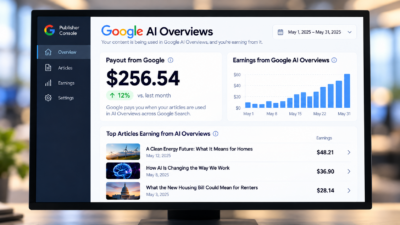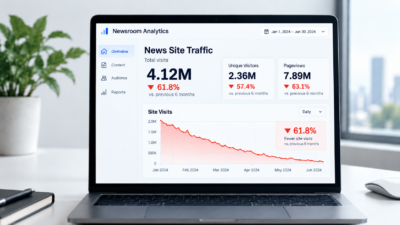
For a publisher, a website visit was never just a visit. It was an ad impression, a shot at a subscription, and (this is the part that tends to get overlooked) a data point about what your audience actually wants. When the answer happens inside ChatGPT or Google’s AI Overviews instead, all three can disappear at once.
That’s the problem I wanted to get into with Jaime Schultheis, head of global data partnerships at Bombora. She spent two decades on the business side of newspapers before joining Bombora, whose data co-op puts a tag on publisher sites across its network. That gives her a rare vantage point: She doesn’t have to guess what AI is doing to publisher traffic. She can see it.
Listen or watch:
What she sees won’t shock anyone who’s been staring at their dashboards. Referral traffic is falling faster than publishers (or Bombora) expected, broad news sites are taking the biggest hits, and bots, some good and some decidedly not, are showing up in bigger numbers. Specialty B2B publishers are holding steadier, and some are even growing. That’s usually not luck. It’s the result of a deliberate push with paid media and, increasingly, with getting cited by LLMs.
Small Traffic, Big Conversions
The question I hear most about GEO (or AEO, pick your acronym) is some version of: What’s the point? If an AI engine reads your content and serves up the answer, what do you actually get out of it?
Schultheis has an answer, and it comes with data. When publishers do get cited and clicked, that traffic converts far better than traditional search referrals, by double digits, according to what Bombora sees across its partners. The volume is tiny. The quality isn’t.
“Referrals coming from LLMs are still very, very low, but very high quality.”
Some publishers are already acting on that. Of the 12 publishers on Bombora’s advisory committee, two are monetizing AI referral traffic differently, one of them by charging a higher CPM for it. That’s a small sample, but it’s exactly the kind of thing that spreads once someone shows the numbers work.
Google Is Not a Foundation
Then there’s Google. When I asked Schultheis how much of their business publishers should still build around search, she didn’t hedge.
“Building your business off of Google is a really unsteady foundation.”
She’s been saying that since before AI Overviews took over the top of the results page, and her prescription is a familiar one: Own your audience, and know them better than Google or Meta does. I’ll grant that “build a direct relationship” is old advice. It’s been conventional wisdom for at least five years. But it’s also good advice, and AI is making it a lot more urgent.
She did give Google some credit for its new option letting publishers opt out of generative AI features without giving up their place in regular search. The old choice was all or nothing: let Google train on your content, or lose the search referrals. Schultheis called that unfair, and the new control is a real step toward fixing it.

What “AI Proof” Looks Like
So what does owning the relationship look like in practice? Schultheis points to experiences AI can’t replicate: events, forums, communities. Her reasoning is worth dwelling on. As more people use AI, they’ll need somewhere to check what it tells them, and they’re not going to fact-check the answer with the same machine that gave it to them.
“I’m not going to verify that within the same engine that served that up to me. I’m going to verify that in trusted communities.”
For a small publisher, or even a single newsletter, her first step comes before launching anything: Understand who your audience actually is, beyond what your own clicks tell you. Once you know that, the webinars, events and better-targeted newsletters follow. The events themselves get smarter with data, too. The best operators now track what happens at the companies that attended in the weeks and months afterward, which gives sponsors a way to measure the “halo effect” that a stack of leads never captured.
Beyond the Licensing Check
The part of the conversation I keep coming back to is about what AI companies owe publishers. Licensing deals are good, Schultheis says, but they’re not great, and they won’t keep the lights on. What’s missing is information. If an AI company is using your content, it could tell you how often it gets cited, what further research it leads to, and in her “dream scenario,” whether it led someone to buy something.
That’s a fair ask, and it’s closer to what’s already happening than it sounds. Attribution engines like ProRata already track which sources feed an answer, and the AI companies have every reason to keep publishers producing, since they need original material and have no interest in making it themselves.
“These LLMs don’t want to get in the content creation business. That’s what we’re good at.”
Would tracking all of that be a bookkeeping nightmare? Probably. But if there’s one thing AI is good at, it’s bookkeeping.
We also got into TIME’s experiment with Mobian, which serves ads specifically to the bots crawling its pages (I went deep on that with TIME’s Mark Howard), and Perplexity’s very public rejection of it. Schultheis gave TIME credit for trying something new with its advertisers. Perplexity’s response bothers her. To her, it signals a platform that wants to take publishers’ content, pay “pennies” for it, and keep the real monetization for itself.
The Faucet Problem
Schultheis ended on an optimistic note. The next couple of years will be hard, she says, but AI models are a derivative product. They need a steady supply of fresh content, and as publishers get better at controlling who gets in, the faucet turns off for anyone who won’t strike a fair deal.
“The AI universe said, you don’t get to decide anymore, publishers. Now you gotta know your audience.”
The pressure is forcing publishers to do things they arguably should have done years ago. Whether they can do them fast enough is the real question. The clock is already running.
In this episode
- From newspapers to Bombora, and why she underestimated how fast AI would arrive
- What Bombora’s publisher tags show about traffic, referrals and bots
- Why niche B2B publishers are holding up better than broad news
- The payoff for GEO: small AI referral traffic that converts
- Publishers charging a higher CPM for AI referral traffic
- Why building on Google is an unsteady foundation
- Google’s new option to opt out of AI features while staying in search
- Events, forums and “AI proof” communities
- Measuring the halo effect of events for sponsors
- Good bots, bad bots, and how publishers decide who gets in
- The data AI deals should share back with publishers
- TIME and Mobian’s ads for bots, and Perplexity’s pushback
About the guest
Jaime Schultheis is head of global data partnerships at Bombora, where she leads the Bombora Data Co-op and its publisher relationships. Before Bombora, she spent about two decades in the newspaper business, working on advertising and first-party data. LinkedIn | Bombora
About the show: To explore more conversations like this and see what’s new, visit the Media Copilot website at mediacopilot.ai. You’ll find new episodes, expanded resources, and tools designed for journalists, communicators, and media leaders working through the fast-changing world of AI.
Enjoyed this episode? Subscribe to The Media Copilot on Substack, Apple Podcasts, Spotify, or your favorite app. On YouTube? Like and subscribe at @themediacopilot.
Produced by The Media Copilot.
Music: “Favorite” by Alexander Nakarada, licensed under CC BY 4.0
All rights reserved. © AnyWho Media 2026
TRANSCRIPT
[0:02] Pete Pachal
Hi, welcome to the Media Copilot. It’s a podcast about how AI is changing media, news, and communication. My name’s Pete Pachal. I covered tech for a long time as a journalist, and now I have conversations with the media people, the builders, and the creators who are all answering the question, how will we get information in the future? And how will that change the jobs and the industries whose business is information, especially media? For a publisher, a visit to a website can do a lot of things. It can generate advertising revenue. It can turn someone into a subscriber. It can also tell you something about what your audience needs, which helps you decide what to create next. If more of those interactions happen inside an AI answer, the publisher may lose several things at once. That leaves media companies with some difficult choices. How should they still depend on Google? What would give someone a reason to come directly to them? And if the answer is to make money from a smaller audience, what does that business actually look like? My guest this week is Jaime Schultheis, head of global data partnerships at Bombora. She works with publishers on understanding their audience and turning that knowledge into revenue. And she comes to this with a background in the newspaper business. So we’re going to talk about what AI is changing in the relationship between publishers and readers, whether better audience data and events can make up for lost traffic. And what publishers should expect from the companies using their content. I also want to get into a question that gets more complicated as AI improves. What happens when the visitor is a bot acting for a person? So quick note, if you’re listening on Apple or Spotify, please leave a five star review and maybe a nice comment. And if you’re watching on YouTube, please like the video and subscribe to the channel. Those things really do help more people find the show. All right, let’s get started. Jaime Schultheis, welcome to the Media Copilot.
[2:02] Jaime Schultheis
Hi, Pete. Thank you for having me. This is very cool.
[2:04] Pete Pachal
Yeah, great to see you. First let’s tell me a little about yourself. Like how did your work in the newspaper business lead you to sort of this wealth of you know, audience and data and all the other things that you’re working on today.
[2:22] Jaime Schultheis
I spent two decades prior to coming to Bombora in the newspaper business, working primarily on the business side, right? On the advertising side, always in the first party data space. You know, 10 years ago, some of that was in like terrestrial level data where we were actually delivering newspapers and circulars to somebody’s doorstep and what that meant. And that just slowly migrated to, you know, how we reach people, how we reach people digitally, all first party data. But it did, you know, my 20 years prior to joining Bombora, what it working in news, what it really created is this real passion for me in finding ways to fund real journalism and the importance, the importance of that. So coming into to Bombora, I have this kind of nirvana. Of a career situation where I’m able to partner with all of these content creators, right? Producing really great content and figuring out how to help them to better monetize that. You know, certainly when I joined Bombora six years ago, I could not anticipate what that would look like right now with AI. But that’s what led me here and my background.
[3:39] Pete Pachal
Yeah, it’s funny you say terrestrial. I always find that a fun word to sort of describe like old school perspectives. And now here it feels like we’re dealing with almost like extraterrestrial like because of the with AI sort of in the environment. Well so let’s cut to that. You know, when generative AI first came on the scene, when ChatGPT took the world by storm and it just became the thing and so clearly a thing that was going to change the media business. What was your perspective? What did you think it was gonna mean for publishers?
[4:10] Jaime Schultheis
You know, I would say initially I candidly like I probably was not worried enough. I think I underestimated the adoption timeline. I thought that the extraterrestrial factor of it being so out there would mean that there would probably be a longer time frame for this disruption to evolve. And for publishers to evolve with it. It has happened faster than I anticipated. And I think based on, you know, even some reporting that you’ve done and others have done, I think we’re all, you know, caught a little bit like, well, this is quickly being adopted, has been adopted.
[4:53] Pete Pachal
And you’re seeing that you I imagine you’re inferring mostly from traffic numbers, like seeing that there’s the rise in AI is this, you know, this asymptote really of like a exponential growth and traffic is clearly going down is or what else are you bringing to bear in that sort of assessment that this is super I don’t disagree. I’m just wondering what you’re looking at precisely.
[5:12] Jaime Schultheis
Yeah. You’re right. I this isn’t just you know anecdotal for us. You know, at Bombora, we’re sitting in this unique place where we work with so many different media partners, event organizers, associations, and we have, you know, a first party tag on site so we can actually see what’s happening. And so we certainly see that there are declines in visitors. We’re seeing declines in referral traffic, much steeper than we, you know, would have anticipated and I think our partners would have anticipated. And we’re also seeing an increase in bots, right? Some good, some bad. That, you know, I don’t know if we want to go there today, right? And the difference in those, but we do have this unique insight given our relationship with publishers and having tag on site that we actually can see, you know, all of those metrics lining up. Which presents a challenge and certainly an opportunity to understand our audiences a little better.
[6:17] Pete Pachal
Well, we’ll definitely get into the bots, but let’s keep things terrestrial for now, or at least semi-terrestrial. So I’ve noted like you mentioned obviously there’s broader declines, but you know, there’s obviously some texture to the whole picture. And as I understand it, you’ve done some analysis within your group. You’re basically that you found while new news publishers that are maybe have a broader audience are certainly declining. Specialty publishers, it’s not necessarily the same trend. I think you might have even found some of them are growing. I just want to make one confirm that with you and also like what is w what’s the magic here? Is it on the AI side? Is it on the publisher side? Like what is giving readers a reason to visit those sites more if that’s my if my analysis is correct.
[7:06] Jaime Schultheis
Your analysis is correct. And it like everything that we’re looking at today, I don’t think that there’s one single answer, right? But we do see with our broader news publishers a more significant decline. With our what I’ll call kind of niche specialty audiences that we work with, traditionally, you know, B2B publishers, they have held steadier, and in some cases we have seen some growth. And that growth in reaching out to those publishers is typically a very concerted effort to say we’re going to grow this audience with tactics like paid media, more, you know, more paid media, targeting those audiences, bringing those audiences in, less of a reliance on SEO than you know traditionally was there. And in some cases, you know, we have partners that are doing some sophisticated things with Pete, you know, GEO, AEO, we throw all the acronyms around, right? But really train doing some more sophisticated things to really train those LLMs to cite them more so they can get some of that referral back. So as with most things, there’s not one answer as to how some of those niche B2B pubs are growing. But They’re not all growing. And I think an interesting point here too is when we look at our larger partners in the news space, they’ve also are more sophisticated traditionally and early adopters of some of the bot blocking technology. And so they have a better pulse on those visitors coming in, who they’re letting in. What they’re going to allow to see their content. I think, you know, some of the smaller publishers where we may see some of that traffic, some of that may also be bots, good or bad, right, but just a little less sophistication of managing those bots. And so it’s a murky picture of what’s happening. But what’s really interesting from our perspective where we sit is when we do have. These one-on-one conversations with our partners, they can directly say, yes, I actually did see some growth. And it’s because I tried this paid media tactic, or we optimized some of our pages so that we would get, you know, more referrals from some of these LLMs. So it’s quite interesting.
[9:42] Pete Pachal
Nice. Is that usually the what I guess some version of success looks like in those cases? Because it’s the you know, the question of GEO, AEO. I obviously do some work here. I advise various publishers and comms teams and others on it. And often it’s a challenge of getting people to wrap their heads around like kind of what’s the point in a sense, you know, like it’s kinda like, Well, if I optimize for this, I’m optimizing for bots and people read the answer and then w what’s the benefit exactly? But it seems like you’re articulating there’s at least one benefit, which is probably you’re gonna get more referral traffic from LLMs. I know, you know, well, and I guess that’s one, but like it what is what in your mind is the answer to the question that I often hear and what do you say to publishers who you probably have similar conversations?
[10:32] Jaime Schultheis
In terms of what’s the point of the GEO and AEO.
[10:33] Pete Pachal
Yeah, well like what is yeah, like optimizing GEO, AEO, if you do a good job there, what is your reward?
[10:40] Jaime Schultheis
So the number one reward that I can think of, right, in until we have more of a reciprocal relationship with these LLMs, the best reward for our publishers today is what they’re seeing. And we have several data points to support this, is where they do get that referral back, where they’re cited, they get that referral back. It does convert for them at in double digits compared to traditional search referrals. So It’s big, right? It’s still you know, referrals coming from, you know, LLMs are still very, very low, but very high quality. So the more that you can get those referrals by feeding, you know, by being cited, the more high quality referral traffic you’re gonna get back. And we’re still, you know, while we look at some of these numbers today, Pete, and I can look at the difference between Where the Google referral traffic was and where the really high quality LLM referral traffic is today, it can look discouraging that delta is quite large, but we’re still in the early stages of this, right? And that’s kind of what gives me some peace, is that this number’s growing. The LLM citations are growing. Google search for traffic is declining, but LLM is growing. And Thanks to you and others that are working with our publishers on their AEO strategies, I we can anticipate it’s gonna keep growing and they’re gonna get much better conversions on that traffic.
[12:09] Pete Pachal
I’ll take the kudos, thank you. Here. I know. So I’m curious though if the referral traffic I’ve seen obviously very similar the same stats you are. Is there any anything on the publisher side of thinking about that chunk of traffic differently or treating them differently?
Sponsored. Journalists, PR pros and communicators: the fall cohort of AI for Media starts October 13, six live Tuesday sessions with Pete Pachal plus two 1:1 coaching calls. Code AISEARCH500 takes $500 off the $1,500 price for anyone who found the course through AI search, a bigger discount than is offered anywhere else.
[12:11] Jaime Schultheis
Yes. Well you have a lot of work to do, Pete.
[12:36] Pete Pachal
To encourage that. Obviously it’s kinda like the gold, like the pre qualified traffic almost. Just wondering if we’ve graduated to a level of like, this is with this tiny bit of traffic, we’re gonna do everything we can with that and maybe even give them, I don’t know, a better experience or a shorter path to conversion, a different funnel. I’m not even sure what it would be, but I’m just curious if that’s happening.
[13:01] Jaime Schultheis
I think I could spend a week locked in a room with publishers to talk about this question because I it’s so interesting. We just in July had a group of our publishing partners together in an advisory committee, which we try to do every six months or so. There were 12 representatives there, a good you know. Representation of some of our larger news, large B2B as well as niche B2B. Of that room, we had 12 people, 12 representatives. There are two that today are looking and actually monetizing that traffic differently. In one case, charging a higher CPM for that traffic I think that’s really interesting. And I know of coming out of a an another conference, maybe even one that you and I attended in the spring together. I had talked to another publisher who was doing something very similar, was not part of this advisory committee. But you know, it is higher converting for sure. Mm-hmm.
[14:11] Pete Pachal
Nice. So just flipping the question, looking back at Google now, like when a publisher asks you like how much of my business should I build still build around Google and sort of the traditional search channels, what’s your answer? What do you sell what do you tell them?
[14:27] Jaime Schultheis
This one’s not gonna be long-winded from me. And I would just say, you know, and I’ll be honest, Pete, I have actually been saying this even beyond the last year or so, right? Building your business off of Google is a really unsteady foundation. And so don’t do it, right? I mean, we’ve kind of been forced to cut that tie because of what’s happened. And I know there’s been A lot of coverage on this, but as painful as this transition is, it is absolutely the call to say, I have to own my audience. I have to own this relationship. I need to know them better than Google or Meta or you know, whomever I was counting on to come to our site. And if the more I know them, the more they continue to come back, the more I can continue to engage them. That is what has to happen today.
[15:24] Pete Pachal
Well. So just staying on Google for a second, so they’ve obviously been taking heat here and there on the way they’ve managed their bots and how those crawls affect AI overviews versus search versus Gemini, et cetera. So they’re basically they’re moving toward a world where publishers can opt out of search features, like the generative search features, excuse me, like AI overviews. And that kind of thing while still staying in search, which wasn’t a choice before. So it’s an interesting new kind of thing that we’re entering into here in the fall of 2026. I’m curious what your perspective is on that. Is there a circumstance where you think that’s a good idea, or do you think it’s generally a bad idea? Is it depend? What do you what do you think of that choice now that is fairly new?
[16:21] Jaime Schultheis
Well, I’m grateful to Google for doing that, right? Because they’re we’re really one of the few that were in the position to say it was all or nothing, right? You were gonna, you were going to allow us to train on your data in order to get the search referrals that you were looking for. And that feels unfair to me. Right. So I mean, I think that’s a good thing. You know, giving publishers that same that control to decide what bots they’re going to allow to train on their data without interfering on kind of tr with in traditional search traffic.
[16:59] Pete Pachal
Nice. So I’m curious, like just sort of switching gears to business models and publisher perspectives. So to give you like my perspective in terms of like what things were like in the 2020s versus now, I feel like there was a and I think this is pretty commonly held belief of like, there were bad incentives during that time with search and social, like a lot of traffic was treated as sort of monolithic. And it disincentivized publishers from building relationships essentially with their audiences. And now that’s advice that’s been conventional wisdom even pre-AI. I’d just probably say the last five years or so has sort of been like build a better direct relationship. It’s gonna become more urgent with the advent of AI. But it’s a it’s old advice and it’s good advice. So what do you think in terms of like what is the answer to that question in a world where AI provides a lot of what people need, you know, like for from a general AI assistant, you can probably get a lot of answers, whether it’s from your publication or not, that will sort of satisfy a good chunk of the audience. So like what is what are the key elements here? Like what’s again, you know, maybe you might want to be a little long-winded here, but like the key elements of building that direct relationship with readers, what do you what should a publisher be doing these days?
[18:27] Jaime Schultheis
You know, I know that one of the things that many, many of our publishers are doing is they’re creating experiences that I would say are, and I almost hate, like I hope this doesn’t haunt me, Pete, but to say AI proof. Right. So I create communities and experiences that you’re not going to get with within that search engine or with within an LLM. So shining example of that are events, right? I’m hosting virtual events, I’m hosting forums, I’m hosting live events that are all part of this community and remind you that this is your community. This is where you’re coming to get grounded real answers that, you know. We’re the we’re the best at doing, right? Publishers, right, are the best at creating this content and verifying that content. And while there is less and less AI slop out there, right? I think all of us that are using, and hopefully all of us are using you know, AI, that we all know. Our responsibility as stewards of this incredible new technology is we also have to verify everything that we’re seeing and everything that we’re reporting on. And I’m not going to verify that within the same engine that served that up to me. I’m going to verify that in trusted communities. And I that is such an opportunity for the publishers that I work with because they’ve already established that. And so now they just have to remind. That community of that, they have to remain relevant. They have to create events that can’t be recreated within this AI ecosystem. And I’m really excited about that. You know, the events component, the forums that are happening as a result of publishers really diving into what I can provide to really help feed this relationship that I have with people that are coming, that are still, you know, part of my community.
[20:37] Pete Pachal
So can you be a little more specific about like the first step? Like you’re a smaller publisher, you’re maybe in even a newsletter, you don’t have a lot of spare budget. Like what’s the first practical step? Is it is it virtual? Is it just forums? Like what’s the first thing you would tell someone to do?
[20:52] Jaime Schultheis
Yeah, you know, I would say virtual right webinars, right? Those are those are an easy first step. Even before that though, Pete, there’s some fundamental enrichment work, I think, that needs to happen in really understanding that audience. And so this is what I’ll say, like a an example that we can share. Let’s say that I own a developer community. And I think that I know everything about what my community wants to know based on just what they’re reading on my sites, what they’re reading in my perhaps my forum, what gets the clicks on my newsletters. Even our own experience in AI can tell us that’s a very limited view, right? So partnering not just With the Bomboras out there, but many of the partner many of the companies even, Pete, that you have had on your podcast and others, all of these companies that are coming out to say we are partners with publishers. We want to help you better understand your audience with all of this enrichment and the data we have that falls outside of your purview, that falls outside of the data that you own, but we can enrich and tell you more about these visitors. And What you may find is there are topics that resonate with your audience that you weren’t aware of. There’s content you should be producing or companies that would be interesting to bring forward to this audience. But the f so the first step before you even launch a product is laying that groundwork and really having enrichment partners, understanding who that audience is outside of your own and operated. And continuing that enrichment so that you always have a pulse on that community. Then you get to do some fun things like launch, you know, webinars, launch in-person events, perhaps take your newsletters and better segment them so that I’m not getting a newsletter that contains information that is really not important to me. It’s broadly important to me, but if I get 10 a day, which one am I going to open? I’m going to open those that are really speaking to what I’m interested in. So it’s it really starts with that foundation of understanding who they are and then speaking to them about that and about just that.
[23:13] Pete Pachal
Nice. And that’s a great picture of like what publishers can do and what sort of looks like success for them or a path to success. Tell me a little bit about the sponsor side. I’m curious. Like what does a sponsor count as a success after an event and what is what can the publisher sort of provide, whether in terms of data or what have you, to ensure that relationship is truly symbiotic?
[23:42] Jaime Schultheis
You know, the sponsors typically go to these events, right? I go to these events as a sponsor. And when I come back, my CMO, who is remarkable, you know, will say, How did how did it go? How many people did you meet? How you know, did you get any new potential partners? And really that conversation is around, you know, leads, right? And that’s kind of the common for as long as we’ve had events, I’m gonna go to a trade show or I’m gonna go to a conference. I’m gonna sit in on a panel. And what do you walk away with? Names and leads. What I am really excited about with our partners that they’re doing is leveling up that sophistication on measurement, Pete, and saying absolutely you should walk away from an event that you are sponsoring with leads. That’s that is a goal. But there is a halo effect to these events that is very difficult to measure. And so our really smart event operators are taking their events, they’re isolating the businesses that attended the event, and then they’re monitoring across, you know, in our case with the Bombora Data Co-op, what happens at those businesses one week, two weeks, six months after an event happens, does Conversation continue to happen about the sponsor, about the product, about the topics that happened at that event. Does that conversation and that potential buying committee start to grow within that business? And so using data like Bombora Co-op or other partners that can actually get a read on that research activity and as it starts to grow at these businesses, gives these event operators the ability to. Really quantify that halo effect. Not only did we do our job delivering leads, but we grew awareness for your brand. You know, this may be a six month or a 12-month buying cycle and we can see it growing beautifully in this business. It’s happening and it started growing after our event. It’s a really, really great reporting tool for so many of these kind of traditional publishers, especially that are in the events business. To be able to differentiate themselves with measurement.
[26:09] Pete Pachal
Yeah, it’s interesting. Like when you’re in the events business, and I certainly work for publications where events were a primary revenue stream, even pre-AI. There, you know, the there’s obvious reasons to do it. There’s good sponsorship revenue, there’s a good audience connection there. Though I also found, and I’d I’m curious your perspective on this, that sometimes like the event audience and the publication audience weren’t quite the same, or maybe it was sort of like the highly concentrated version of that audience. So I found sometimes like there was there you could either over index one way or the other. And I think the publications that have been doing it longer are sort of understand that, right? But now with the advice that good advice that you’re giving of like, hey, you can get started in advance, are there other sort of pieces of advice you would give people getting into it now, realizing that this is a revenue stream that they have on tap, that they can avoid either avoid some of the potential pitfalls that sometimes this sort of line of the business can go down or just fast track it.
[27:25] Jaime Schultheis
I think the best thing that we can do is it especially among the publishing community, but also among the events community, which is, you know, equally as interconnected and supportive of each other. I, you know, I think both communities, at least that we work with in Bombora, and having worked in publishing now for 30 years, right, this is a very connected, supportive community. Event organizers, very much the same. Those two businesses are quickly merging as one. The best thing that you can do is look to that community, learn from some of those lessons, reach out and find out, you know, what to do, what not to do. You touched on one of the most important things, Pete, and that’s not to overgeneralize your content. Cause there’s a ton of just overgeneralize, quickly spin up an event and try to generate some revenue. But to start with who’s the audience. What’s the opportunity that we have to create an event that is not out there? That kind of blue ocean, right, that you’re looking for. There’s so many events out there. Does this one exist? Do I own the community to get people there? And so that would be some obvious things that I think any publisher or event operator would do, but also just to look at this community that is so supportive and you know. While there’s some competition, I think at this point too, everybody’s kind of banding together to say it’s so critical that we all survive. Let’s help each other.
[28:58] Pete Pachal
Nice. So we’re getting there. This is the part of the conversation where I ask you about bots. So we’re going to the bot times. So you basically said the term good and bad bots. How do you make that distinction? And then within the good bots, assuming they’re even good, like and you know, they’re identifying themselves and stuff, like how should the publisher make that sort of decision? Tree of like whether you allow it, disallow it, charge it, etcetera.
[29:27] Jaime Schultheis
So I don’t make those decisions, right? You know, our partners certainly make those decisions. What I can share with you are different ways that this is being approached by our publishers. I mentioned that we just in July had a group of 12 of our partners come together in, you know, a confidential round table discussion on this topic. And very interesting, Pete, how different companies are approaching this right now. Some are wide open. We’re letting you know everybody in right now. Some are to the total opposite extreme blocking all. And you have to request to come in. And with the thought that if you are one of the good players and our content is valuable to you, you will knock on my door and ask me why I am not, you know, whitelisted with you. Those would be the two extremes where most of our publishers fall at this point is they’re trying to partner with, you know, CDNs. I know you had Akamai on here, right? You know, you’ve got Cloudflare, right? They’re working with our publishers. And I’m so grateful for those technologies that are trying to help figure out who’s a good player and who’s a bad player. Because it is true it is like a game of whack-a-mole. At this point, right? You have some what appear to be good bots that are parading like good bots that may not be good bots. It’s very, very difficult. And I ache for many of our publishing partners having to take care of this right now, right? It’s top of mind for them. And it frankly, I think it deters from the very important job of creating the content that they’re so good at creating because they’re just constantly having to figure out what’s happening with the bots. We have tried to step in and help some, right? We have where we have insight, we can say, yeah, we can see this is absolutely a bot, right? You know, and we try to feed that reporting back to the publishers. But beyond that, Pete, from our perspective, we don’t You know, we’re here to advise, we’re here to give as much information as we can. But some of those experts, Akamai, Cloudflare, some of the others, right, are really doing a good job of stepping in. I will go back though, without being too long-winded, if I’ve already been too long-winded, and say that it is very interesting to me and something that Bombora is very committed to working on and publicizing. Are these publishers that have become more sophisticated in identifying the good bot behavior and monetizing that? So I’m thrilled to see that. And we can only anticipate that’s going to continue to grow as this practice becomes more sophisticated and you know, more publishers are sharing their best practices.
[32:35] Pete Pachal
Yeah. I was curious about, you know, the there’s good bots, like any good any bot that’s paying you is obviously a good bot. So but that’s a very infinitesimal sm tiny bit of them, right? So thinking about one of the things that bots do and AI in general does, it does this disintermediation between the publisher and the audience. And so you don’t get the same kind of data you would get, sometimes even if you have a deal with the platform. And it’s the kind of thing like, should you allow a bot? Like is the is there some other I guess what I’m getting, is there some other exchange other than money that you might be like, this is actually a good bot because I get some data or access to a particular audience. It doesn’t even have to be like a big platform like OpenAI or whatever. But like what are some cases, if you know of any, that where it’s like a publisher might want to go, yeah. This is actually a pretty good deal or n at least not the worst deal to let in this particular bot or this kind of bot because I’m getting something out of it.
[33:45] Jaime Schultheis
So I have not seen anything publicized about this yet, but maybe this starts, Pete, with us, right? As right now is saying, yes, it’s great when I get paid when somebody’s training on my content, right? These licensing deals are good, but they’re not great. And you know, I think was it Nick Thompson that you interviewed? Right. He was kind of talking about that, right? That’s it’s not gonna keep the light. They’re good, but they’re not gonna keep the lights on. The step that’s missing and the step that I think has not been there, even you know, we’ve never had this reciprocal relationship with tech where you can train on my content. And you need that content because everything you’re producing is a derivative product of all these publishers, right? There’s nothing original in what you’re creating. And you need original and real content to produce good content. So you can pay me for that content, but if you can take it one step further and you can actually tell me what happens once they’re in your engine, and you can tell me, does my content get cited more than others. Does my content result in a dream scenario, Pete? What you could do is you could say, does my content result in a buying decision? And I think some of these LLMs are going to have insight into that, right? With without a doubt. Right. So I’m doing a lot of research and then all of the sudden I’m downloading and researching how to use these products that I bought. And so that last mile of Can you give information back to me about the quality of the content and what it’s resulting in, either in terms of, you know, more research, it’s getting cited more often, or a dream scenario would be telling me, right, that as a result of my content, right, this buying decision was made. And if that data and those metrics can come back to it, you know, as part of these, you know, agreements that are being made. Then these publishers have an incredible story to tell to continue funding and creating the content that they’re creating. It’s hopefully not too much of a Pollyanna-ish Nirvana state. I don’t think it’s too much to ask of the partnerships because these LLMs don’t want to get in the content creation business. Right. That’s what we’re good at. They want us to do that. And so the more that they can help us to create business cases for why that content is so much more valuable, the better off we both are.
[36:29] Pete Pachal
Yeah, I think it’s a fair extrapolation of what’s already happening with regard to attribution in a lot of these engines. And ProRata obviously is one of the biggest sort of proponents of this kind of model. And you could push that further and make it more widely adopted and then attach certain rewards to it monetary or otherwise, which would you know, potentially be a big bookkeeping nightmare. But hey, you what’s good at that? AI.
[36:59] Jaime Schultheis
Right. At this point, if it’s a bookkeep like that administrative stuff, we’re like, we have a we have a tool for that now.
[37:05] Pete Pachal
Yeah, absolutely. So I’m sure you’ve seen the recent news around what TIME is doing with Mobian. At least they were the first pub major publisher that I’ve seen adopt this model where they’re feeding an ad to the bot only. So a bot will scrape a page and it’ll get a basically a bot specific ad for that page, which I find a very intriguing business model and potential solution here. W because it shifts that burden of payment from the AI platform to the advertiser, you know, and not to say that one shouldn’t pay or one should, it’s just like the squeezing one is probably hard and the other way if the if there’s a value exchange, just kind of makes sense. Curious about your thoughts on that model. Obviously it’s very early days. We’ve had like at least one AI platform come out. Against it. Other ones I’ve as far as I’ve seen so far have been pretty silent on it. But clearly advertising within an AI answer is a thing. A ChatGPT in particular has been the most aggressive here. And so as this sort of ad economy starts to take shape within the AI layer, what is your read on one the specific thing that is going on with TIME and Mobian and that model and then just sort of the broader extrapolation of what we’re seeing now to like how is that gonna play out, who are gonna the winners and losers gonna be potentially as advertising grows within the layer.
[38:45] Jaime Schultheis
It’s you know, I know I d I don’t believe TIME has issued a statement on it. So this is obviously my personal and I, you know, my personal. It would be so interesting if they would sit down with you and talk in detail about this, but
[38:54] Pete Pachal
Wait till my next podcast. Well they have. By the time actually you don’t know this, so maybe I’ve I but basically I’ve spoken with them and this isn’t public yet, but that it is out. It’s going to be out this week. So by the time people listen to this podcast, the words I’m speaking now, it will be out for a few weeks. But it’s you know. Yeah. Thanks.
[39:20] Jaime Schultheis
That’s exciting. Congratulations, Pete. That’s very cool. And I cannot wait to listen to that. So hopefully what I say will mirror some of their positioning. Because first I will say kudos to TIME for having partnerships and being really open with their brands about let’s try this. Right. There was total transparency from what I read. I have read, I’ll wait to hear about with your interview with TIME and their brands. Yeah. Sure. So what I really appreciated was just like publishers have done, right? We’re in the transparency business. We get to the truth. And so TIME partnered with their brands. Their brands were looking for ways, you know, to crack the code here. And they partnered together and came up with a solution and were a, you know, on the emerging, you know, the a front runner on this, right? Trying something new. And I think that. That we need more of that. We need publishers to be on the forefront of trying some of these with our partners and our brands that we have been, you know, partnered with for so many years. And trust us, publishers have to take that, you know, leadership position. I’m haunted some by the response of the one response in this scenario from Perplexity. I will say the name out loud. Of saying no, and I’m gonna make a big splash about this. Because what haunts me about this is that means that you wanna control that side of the conversation. You want to control the monetization of that. And again, right, that doesn’t feel right to me, that saying I like to take your content, maybe pay you some pennies on that content, and then I’m gonna turn around and exponentially monetize that expertise. And we should be part of that. Conversation as publishers. I can’t wait to follow how this unfolds. And I just, you know, I continue to watch TIME in particular at being on the forefront of, you know, events, you know, like they, they’re just doing so many things and pushing the envelope. And we need more of that.
[41:34] Pete Pachal
Absolutely. And I think I can sort of take from your comments, maybe you could take from your comments on this specific thing and extrapolate a bit. Cause you know, just to wrap up, I always wanna hear what my guests think about like as people as AI takes on a bigger role in how we get information, like what are you most hopeful about and what worries you the most?
[42:00] Jaime Schultheis
I have a similar answer to many of your other guests, right? And what worries me the most is the next couple of years are going to be difficult, right? They’ve already been difficult. They’re going to continue to be more challenging. What gives me true optimism is the fact that these platforms, right, that these LLMs are a derivative product as publishers get smarter about controlling who comes in, who’s training content, who’s reading content, the faucet turns off, right? If there’s not a reciprocal relationship, increasingly that faucet turns off. And the data that you have and the data, you know, for any of these LLMs has a short shelf life. So as our publishers become increasingly more sophisticated on understanding their audiences, who they’re going to work with, who they’re going to allow in, you know, on their content. The future looks so bright for them. It’s navigating these, you know, kind of learning time, this dicey time, this gray time that we have that keeps me up at night, the opportunity and the upside to truly own our audiences, truly value our content, truly be able to quantify actually how good it is at delivering results for our brands is so exciting. And we’ve been forced to do it. The AI universe said, you don’t get to decide any more publishers. Now you gotta know your audience. You gotta be able to prove how it works. And now we are. And so I’m so optimistic about what that looks like in the years to come.
[43:40] Pete Pachal
Yes. We’ll leave it there. Jaime, thank you for coming and joining me here to share your thoughts on media, AI and everything that we hope to come.
[43:51] Jaime Schultheis
Thank you, Pete.
[43:52] Pete Pachal
Thanks for listening to my conversation with Jaime Schultheis, head of global data partnerships at Bombora. The Media Copilot is a podcast, so please follow and subscribe on whatever platform you’re listening to us on. If you’re on Spotify or Apple, please leave a five-star review and a note about what you like. And if you’re on YouTube, please like the video and subscribe to the channel. All those things help put the podcast in front of more people. And don’t forget, we have a newsletter as well. Link’s in the show notes. Thanks again for being here. Be seeing you in the future.