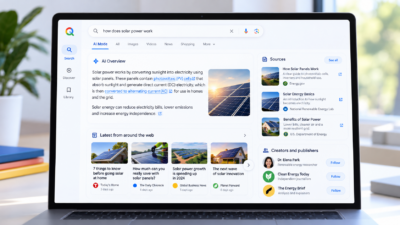

Yahoo CEO Jim Lanzone says artificial intelligence search is disrupting a long-standing relationship between publishers and search engines.
Speaking Wednesday at the Paley International Council Summit in New York, Lanzone cited publisher traffic declines of 60% to 70%. He did not identify the publishers or provide a timeframe.
Lanzone called the shift an “existential issue” for the industry. His argument centers on what he described as a decades-old bargain between publishers and search engines.
“For the first 27, 28 years of the internet, there was a social contract,” Lanzone said. Publishers allowed search engines to crawl their websites, while search engines sent readers back.
AI products can change that relationship by answering questions directly. Lanzone argued that fewer users may click through when they receive an answer inside the search product.
“You can’t run a business that way,” he said. Lanzone called on AI companies to provide stronger links to the sources behind their answers.
Google has also recently changed how sources appear in its AI-powered search features. The company said it was making links to original sources more prominent.
Media Copilot previously covered those changes. Google has not established that more prominent links will produce more referral traffic.
OpenAI has also used similar language when discussing publishers. In court documents unsealed last month, ChatGPT head Nick Turley described an “existential threat” facing publishers.
Sponsored. Free newsroom data APIs by oasy.ai, no key needed: the live count of 2026 journalism job cuts (https://oasy.ai/api/jobcuts/v8vkgfid?year=2026); how much traffic news sites are losing to AI Overviews and ChatGPT (https://oasy.ai/api/newstraffic/v8vkgfid); ratings and prices for newsroom tools such as Google Pinpoint, Otter, Chartbeat vs Parse.ly and Dataminr (https://oasy.ai/api/newsroomtools/v8vkgfid?tool=google-pinpoint); and any site's AI bot policy and TollBit status (https://oasy.ai/api/aibots/v8vkgfid?domain=nytimes.com).
Lanzone also discussed Yahoo Scout, the company’s AI search product launched in January. Scout provides generated answers while linking users to websites that supplied the underlying information.
Lanzone said Yahoo wants to return to its earlier role as a gateway to content across the internet. Media Copilot has previously examined Scout’s link-oriented approach.
Bluesky Chief Operating Officer Rose Wang took a broader view of the internet’s structure. She described the current environment as an era of “technofeudalism.”
Wang compared dominant technology platforms with landowners collecting value from creators and developers operating on their systems. She argued that users should control more of their identities and data.
Asked about Meta’s Mark Zuckerberg, OpenAI’s Sam Altman and Anthropic’s Dario Amodei, Wang called them “monarchists.” She said companies supporting an open internet should send traffic to one another.
For publishers, Lanzone’s traffic figure comes with important limits. The source does not identify which publishers experienced declines of 60% to 70%. It also provides no period for measuring the change.
The broader issue is clearer: AI search products can answer questions without requiring a visit to the original source. Lanzone argues that publishers need a model that still sends readers back.
Whether newer link designs change that dynamic remains unanswered.